Introduction
Aeration serves as the backbone of biological wastewater treatment, deployed in approximately 90% of municipal and industrial treatment plants worldwide. This critical process accounts for 25% to 60% of a plant's total energy consumption, making it both the most essential and most expensive operational component.
With rising energy costs and tightening regulatory requirements, operators face mounting pressure to optimize aeration systems while maintaining dissolved oxygen levels necessary to meet discharge permits.
Yet despite universal adoption, many facilities struggle with inefficient systems and excessive energy costs—challenges rooted in poor understanding of aeration fundamentals and improper system selection. This guide breaks down the mechanisms, system types, and performance factors that determine both treatment success and operational costs.
Key Takeaways
- Aerobic bacteria need dissolved oxygen to break down organic pollutants in wastewater
- Uses 25-60% of plant energy—efficiency directly impacts operating costs
- Three primary systems: surface aerators, diffused air, and submerged jet aeration
- Key metrics: oxygen transfer efficiency (OTE), and energy consumption
- Choose systems based on tank depth, wastewater type, and treatment goals
What Is Aeration in Wastewater Treatment?
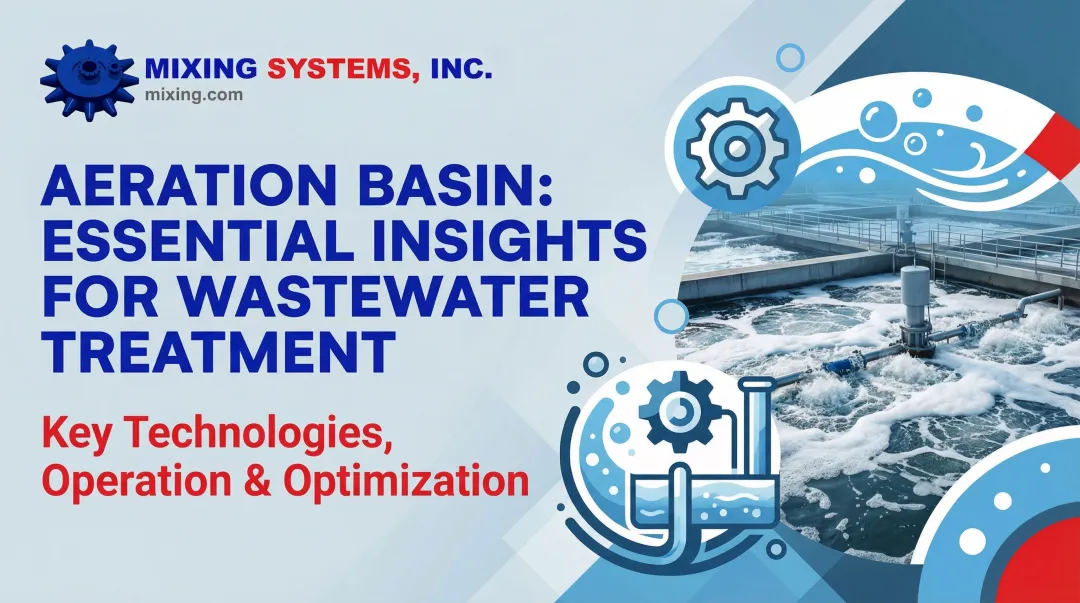
Aeration is the process of dissolving atmospheric oxygen into wastewater to create aerobic conditions that enable microorganisms to break down organic contaminants. Without adequate dissolved oxygen, aerobic bacteria cannot break down biochemical oxygen demand (BOD) and chemical oxygen demand (COD)—the primary measures of organic pollution.
When oxygen levels drop below critical thresholds, treatment systems become anaerobic, producing foul odors, sludge bulking, and permit violations that can result in regulatory penalties.
Aeration is not simply "bubbling air" through water.
Effective aeration requires precise oxygen transfer rates matched to biological oxygen demand. It also needs proper mixing to prevent dead zones where bacteria cannot access oxygen, plus continuous dissolved oxygen monitoring to maintain optimal conditions. The process must balance energy input with treatment needs—over-aeration wastes electricity, while under-aeration compromises treatment performance.
This balance explains why conventional aeration remains the most cost-effective treatment method despite advances in membrane bioreactors and other technologies. Modern innovation focuses on improving energy efficiency rather than replacing aeration entirely.
Key Selection Factors
Systems vary by bubble size, energy source, and oxygen transfer mechanism, with selection depending on factors including:
- Tank geometry and depth
- Wastewater strength and composition
- Treatment performance requirements
- Capital and operational budget constraints
- Maintenance capabilities
How Does Aeration Work?
Aeration operates through a coordinated sequence of physical, chemical, and biological processes that transform pollutants into stable end products.
Oxygen Transfer and Dissolution
The aeration device—whether diffuser, impeller, or nozzle—creates an air-water interface where oxygen molecules transfer from gas phase to liquid phase based on concentration gradients. The transfer rate depends on the difference between oxygen saturation concentration and actual dissolved oxygen in the water.
Bubble size and contact time play critical roles. Smaller bubbles provide larger surface area per unit volume and slower rise velocity, maximizing oxygen dissolution before reaching the surface. Fine bubbles (1-3mm diameter) can achieve 15-30% oxygen transfer efficiency, while coarse bubbles (>3mm) typically reach only 5-10% due to their rapid rise and limited contact time.
Environmental conditions significantly impact oxygen transfer efficiency:
- Temperature: Oxygen solubility ranges from 14.6 mg/L at 0°C to just 7.6 mg/L at 30°C
- Salinity: Reduces dissolved oxygen capacity by approximately 20% compared to freshwater
- Altitude: Decreases saturation concentrations by roughly 7% at 600 meters elevation
- Surfactants and detergents: Reduce mass transfer rates by 10-40% by forming rigid caps on bubble surfaces
Microbial Oxygen Uptake
Once dissolved, oxygen diffuses into activated sludge flocs. Aerobic bacteria consume it during cellular respiration to oxidize organic matter, removing BOD and COD by converting soluble organic compounds into bacterial biomass (sludge), carbon dioxide, and water.
The relationship between food-to-microorganism (F/M) ratio and oxygen demand is direct: higher organic loads require proportionally more aeration to maintain the 2.0+ mg/L dissolved oxygen necessary for optimal treatment. Oxygen demand is highest at the aeration basin inlet where fresh wastewater enters, then decreases as bacteria consume organic matter.
Nitrifying bacteria add significant oxygen demand when nitrogen removal is required. Ammonia oxidation to nitrate requires approximately 4.57 grams of oxygen per gram of ammonia-nitrogen, often doubling total oxygen requirements in plants with nitrogen removal mandates.
Mixing and Solids Suspension
Effective aeration provides both oxygen transfer AND mixing energy to keep activated sludge in suspension. Without adequate mixing, solids settle to the basin floor, creating dead zones with low dissolved oxygen that become septic and produce odors. Bacteria in these zones cannot access wastewater, reducing treatment efficiency.
Excessive mixing creates problems too. It can shear flocs—breaking apart the bacterial aggregates that enable efficient settling in clarifiers—reducing sludge settling properties and causing solids carryover in the effluent.
Mixing requirements vary significantly by tank geometry. Deep tanks need more intense aeration at the bottom to overcome hydrostatic pressure and maintain circulation patterns that prevent short-circuiting and ensure uniform contact between microbes and wastewater.
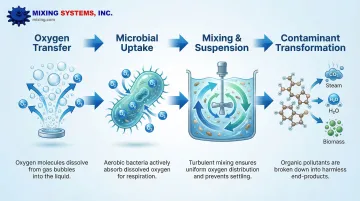
Contaminant Transformation and Gas Stripping
Aerobic metabolism converts soluble BOD into bacterial biomass, carbon dioxide, and water—stable end products that can be separated from treated water. Continuous aeration maintains stable dissolved oxygen levels (typically 2.0-4.0 mg/L) throughout treatment cycles, preventing process upsets that compromise effluent quality.
Aeration also strips volatile compounds and excess dissolved gases from wastewater. The turbulence removes substances like hydrogen sulfide, methane, and volatile organic compounds that can cause odors or interfere with downstream treatment processes.
Types of Aeration Systems
Aeration systems fall into three main categories, each with distinct oxygen transfer mechanisms, energy profiles, and ideal applications.
Mechanical Surface Aeration
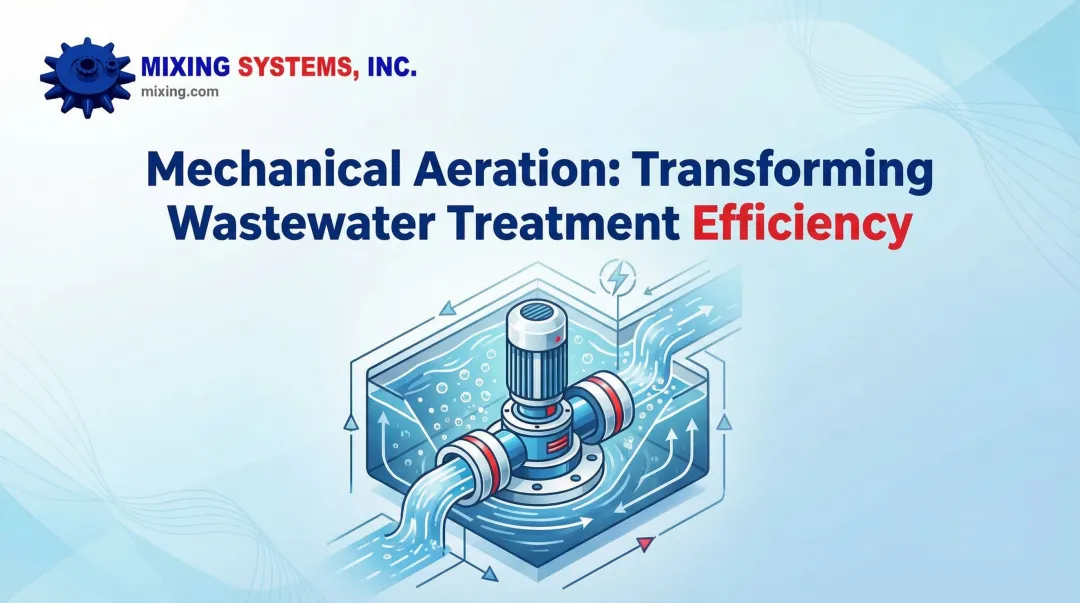
Mechanical systems use rotating impellers or brush rotors to agitate the water surface, drawing in atmospheric oxygen through turbulence and spray. As the impeller churns water, it creates droplets and thin films with large surface areas exposed to air.
Performance characteristics:
- Best for shallow applications (10-15 feet deep)
- Lower capital cost but higher energy consumption
- Ideal for lagoons and oxidation ditches
Mechanical aerators provide robust mixing and simple operation but create aerosols that can spread microorganisms and produce freezing problems in cold climates.
Efficiency can be improved by installing automated weirs to adjust impeller submergence based on dissolved oxygen requirements.
Diffused Aeration Systems
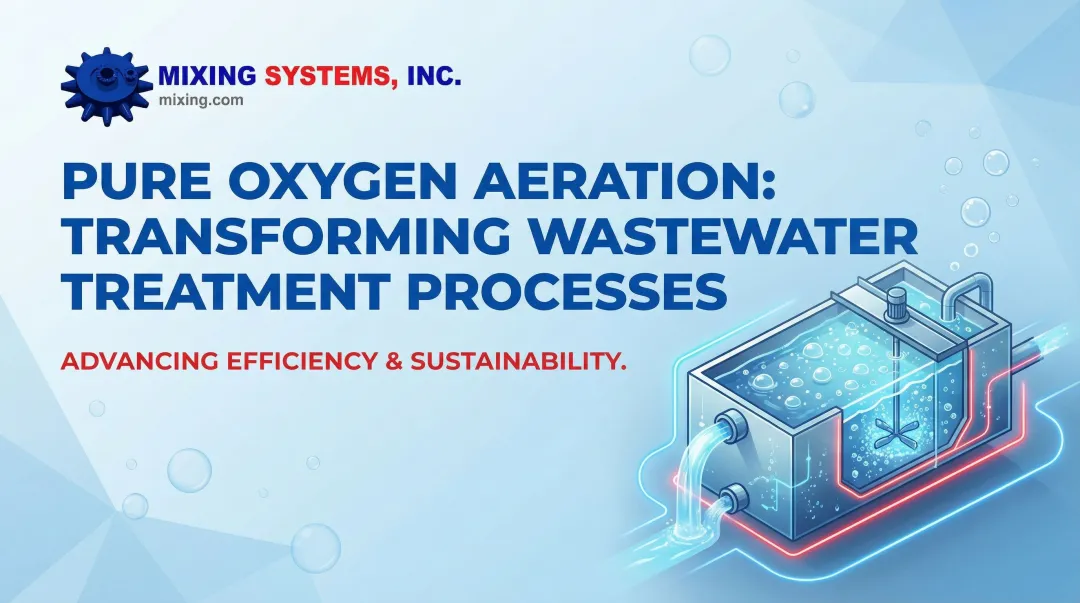
Compressed air is released through submerged diffusers that create fine bubbles (1-3mm) or coarse bubbles (>3mm). Blowers supply air through distribution piping to diffusers mounted on the basin floor.
Fine bubble systems:
- Highest energy efficiency among common technologies
- Ideal for deep tanks (15-30 feet)
- Achieve 30-50% lower operating costs than mechanical systems
- Higher upfront cost due to blowers and piping infrastructure
- Require regular maintenance to prevent fouling
Fine bubble diffusers benefit significantly from depth. Each additional meter of submergence increases oxygen transfer efficiency by approximately 6-7% due to higher partial pressure and longer bubble contact time.
Field studies show fine bubble systems achieving 9.5% oxygen transfer efficiency compared to 4.8% for coarse bubble systems in similar conditions.
Coarse bubble systems:
- Lower efficiency but excellent fouling resistance
- Primarily used for mixing rather than efficient oxygen transfer
- Common in grit chambers and sludge holding tanks
While diffused systems dominate municipal applications, a third technology offers distinct advantages for industrial wastewater treatment.
Jet Aeration Systems
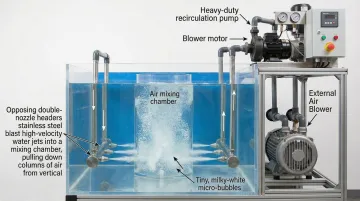
Jet aeration uses submerged nozzles to create high-velocity liquid jets that entrain and shear air into micro-bubbles. This technology combines oxygen transfer with intense mixing in a single device, eliminating the need for separate mixing equipment.
Performance Benefits:
- Energy reductions up to 40% over conventional methods
- Superior oxygen transfer efficiency with micro-bubbles (0.1-1mm diameter)
- All mechanical components located outside tanks for easy maintenance
- Horizontal plume injection maintains gas/liquid interface longer than vertical bubble diffusion
- Particularly effective in deep tanks and high-strength industrial wastewater
- Optional pneumatic backflush system prevents clogging
Jet systems excel in applications requiring both high oxygen transfer and thorough mixing—common in industrial wastewater with high organic loads, surfactants, or suspended solids. The double nozzle arrangement with high shear mixing chamber creates multiple oxygen transfer zones, maximizing mass transfer rates while maintaining solids suspension. Mixing Systems, Inc. has specialized in engineering custom jet aeration systems for over 40 years, with hundreds of installations serving chemical, pharmaceutical, and food processing facilities worldwide.
Comparison Framework
Mechanical systems work best for small, shallow applications with lower capital budgets and when simplicity is prioritized over energy efficiency.
Fine bubble diffused systems are ideal for municipal plants and applications where energy efficiency is critical, particularly in deep tanks where the technology achieves maximum performance.
Jet aeration systems excel for industrial applications requiring both high oxygen transfer and thorough mixing, especially in deep tanks or high-strength wastewater where energy savings and low maintenance justify higher initial investment.
Key Performance Metrics for Aeration Systems
Oxygen Transfer Efficiency (OTE)
OTE measures the percentage of oxygen in supplied air that actually dissolves in wastewater. This metric varies significantly by system type and operating conditions:
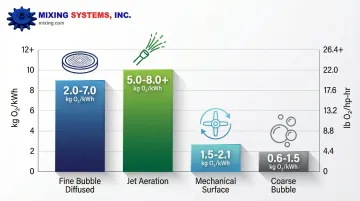
- Fine bubble systems: 15-30% OTE under field conditions
- Coarse bubble systems: 5-10% OTE
- Mechanical surface aerators: Variable, depends on submergence and design
These field values are significantly lower than manufacturer specifications because testing occurs in clean water under ideal conditions.
Real-world performance is typically 40-60% of clean water values due to surfactants (surface-active agents), suspended solids, and temperature effects.
Standard Oxygen Transfer Rate (SOTR)
SOTR represents the mass of oxygen transferred per hour under standard conditions: clean water at 20°C, zero dissolved oxygen, and 1 atmosphere pressure.
Manufacturers provide SOTR data, but operators must convert these values to actual field conditions using correction factors:
- Alpha factor (α): Ratio of wastewater to clean water mass transfer coefficient, typically 0.4-0.7
- Beta factor (β): Ratio of wastewater to clean water saturation concentration, typically 0.95-0.99
- Theta factor (θ): Temperature correction, typically 1.024
- Omega factor (Ω): Pressure correction for altitude
The conversion equation:
OTRfield = SOTR × α × θ(T-20) × [(β × Ω × C20 - CL) / C20]
Where C*20 is saturation concentration at 20°C and CL is actual dissolved oxygen level.
Jet aeration systems typically deliver excellent energy efficiency due to their unique mixing dynamics and micro-bubble generation. Systems like those from Mixing Systems, Inc. can achieve energy reductions of up to 40% compared to conventional methods.
Operators should benchmark their systems against industry standards. Facilities operating below typical efficiency values should investigate fouling, mechanical wear, or control issues.
Factors Affecting Aeration Efficiency
Temperature Effects
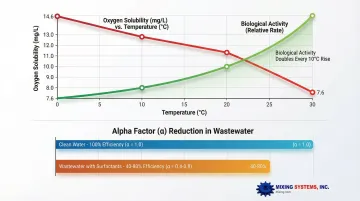
Temperature creates a challenging divergence between oxygen supply capacity and biological demand. Oxygen solubility decreases as temperature rises—from 14.6 mg/L at 0°C to 7.6 mg/L at 30°C—reducing the driving force for mass transfer.
This means facilities need more aeration capacity to achieve the same dissolved oxygen levels in warmer conditions.
At the same time, biological oxygen uptake rates approximately double with every 10°C increase (Q10 effect). Summer conditions create a perfect storm: reduced oxygen transfer capacity precisely when biological demand peaks.
Key temperature considerations include:
- Oxygen solubility drops nearly 50% from winter to summer conditions
- Microbial activity doubles with each 10°C temperature rise
- Systems must handle peak summer loads while avoiding over-aeration in cooler months
- Design capacity needs 30-40% buffer above average demand to accommodate seasonal variation
Water Depth and Hydrostatic Pressure
Deeper submergence increases oxygen transfer by raising the partial pressure of oxygen at the point of release. This effect is particularly beneficial for fine bubble systems, which gain approximately 6-7% efficiency per meter of depth due to longer bubble residence time and higher dissolution pressure.
Fine bubble systems achieve maximum efficiency in tanks exceeding 20 feet deep, where hydrostatic pressure significantly enhances mass transfer. Mechanical surface aerators, conversely, lose effectiveness beyond 12-15 feet because they cannot adequately mix deeper zones or overcome the energy required to lift water to the surface.
Wastewater Characteristics
Wastewater constituents dramatically affect oxygen transfer performance. Surfactants, oils, and suspended solids reduce transfer rates by 20-50% compared to clean water.
These contaminants accumulate at bubble surfaces and create rigid interfaces that inhibit oxygen dissolution.
The alpha factor quantifies this inhibition. While clean water testing might show 30% oxygen transfer efficiency, the same diffuser in wastewater with an alpha factor of 0.5 achieves only 15% efficiency. Typical alpha factors range from 0.4 to 0.8 depending on industrial contributions and treatment stage, with values lowest in raw wastewater and highest after primary clarification.
Industrial wastewater often contains higher surfactant concentrations, requiring conservative design approaches with alpha factors at the lower end of the range. Municipal wastewater with significant industrial contributions should be tested to determine site-specific alpha values rather than relying on literature values.
Understanding these efficiency factors helps facilities select appropriate aeration technology. Jet aeration systems, for instance, maintain more consistent performance across varying wastewater characteristics due to their high-shear mixing chambers and micro-bubble generation, making them particularly effective in industrial applications where alpha factors fluctuate.
Conclusion
Aeration represents the energy-intensive heart of biological wastewater treatment. System selection and optimization directly impact both treatment performance and operating costs.
Understanding oxygen transfer mechanisms, system types, and performance factors enables operators and engineers to select appropriate technologies, troubleshoot problems, and achieve energy savings of 20-40% through proper system design and operation.
The path to optimization begins with understanding current performance:
- Measuring dissolved oxygen profiles across treatment zones
- Calculating actual oxygen transfer efficiency
- Benchmarking energy consumption against industry standards
Armed with this data, facilities can implement targeted improvements. Options range from simple dissolved oxygen control systems to complete aeration system retrofits using technologies like jet aeration or diffused air systems. These improvements deliver substantial cost savings while maintaining or improving treatment performance.
Frequently Asked Questions
How much does aeration typically cost to operate in a wastewater treatment plant?
Aeration accounts for 25-60% of total plant electricity costs, making it the single largest controllable energy expense. Annual costs range from $50,000 for small facilities to over $500,000 for large plants, depending on system size and efficiency.
What dissolved oxygen level should be maintained in an aeration basin?
Most activated sludge systems target 2.0-4.0 mg/L dissolved oxygen, with a minimum of 2.0 mg/L to prevent septic conditions. Nitrification processes require maintaining DO above 2.0 mg/L in aerobic zones.
How often should aeration equipment be cleaned or replaced?
Inspection schedules vary by technology. Jet aeration systems require minimal maintenance with external mechanical assemblies accessible without draining tanks. Diffused air systems typically need cleaning every 2-5 years with 7-12 year service life before replacement.
Can I reduce aeration costs without affecting treatment performance?
Yes. Install DO control systems that adjust airflow based on real-time demand, maintain equipment to preserve transfer efficiency, and evaluate high-efficiency technologies like jet aeration systems that can reduce energy consumption by 30-50% compared to conventional methods.
What causes low dissolved oxygen levels despite running aerators continuously?
Common causes include fouled equipment reducing transfer efficiency, undersized systems for current loading, dead zones preventing adequate mixing, sudden organic loading increases, or temperature rises that reduce oxygen solubility while increasing biological demand.
Which aeration system is most energy-efficient for deep tanks?
Jet aeration and fine bubble systems excel in deep tanks exceeding 15 feet by leveraging hydrostatic pressure and extended contact time, achieving significant energy savings compared to surface aerators. Jet systems offer added benefits of no in-basin moving parts and easier maintenance.