Introduction
Wastewater treatment facilities struggle with aging infrastructure, stricter regulatory limits, and increasing organic loads. Facilities across the US face dissolved oxygen permit limits tied to impaired receiving waters, while regional authorities identify oxygen optimization as critical to avoiding effluent discharge violations.
The core bottleneck: conventional air-based aeration systems can't deliver sufficient oxygen when facilities need it most.
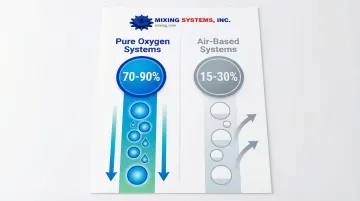
Pure oxygen aeration achieves oxygen transfer efficiencies of 70-90%—compared to just 15-30% for compressed air systems. This article explores how pure oxygen technology transforms treatment capacity, efficiency, and compliance without costly civil works.
TLDR:
- Pure oxygen systems achieve 70-90% transfer efficiency versus 15-30% for air systems
- Increase treatment capacity up to 450% within existing footprints
- Energy savings of 25-60% are typical despite oxygen generation costs
- Reduce VOC stripping by up to 90% and minimize odor issues
- Deploy in weeks to months with minimal process disruption
Understanding Pure Oxygen Aeration: The Basics
What Sets Pure Oxygen Apart from Conventional Air
Pure oxygen aeration fundamentally differs from traditional systems by using gas containing >90% oxygen instead of atmospheric air's 21% oxygen concentration.
This change creates a dramatic shift in treatment physics and performance.
The partial pressure advantage drives superior performance:
- Pure oxygen's partial pressure is approximately 4.7 times higher than atmospheric air
- This increased driving force enables higher dissolved oxygen concentrations at lower gas flow rates
- According to Henry's Law, saturation concentration in liquid is directly proportional to gas-phase partial pressure
Oxygen Transfer Efficiency: The Critical Performance Gap
This partial pressure advantage directly impacts oxygen transfer efficiency (OTE):
Pure Oxygen Systems:
- Target OTE: 70-90%
- Most supplied oxygen dissolves into wastewater
- Minimal waste of compression energy
Air-Based Systems:
- Standard OTE: Less than 15%
- Significant energy wasted on undissolved nitrogen and oxygen off-gas
- Lower mass transfer coefficients limit performance
The Role of Dissolved Oxygen in Biological Treatment
Beyond transfer efficiency, dissolved oxygen (DO) levels determine whether biological treatment succeeds or fails:
- BOD/COD Removal: Adequate DO ensures complete breakdown of organic matter
- Nitrification: Minimum 1.5 mg/L DO required in initial oxic zones, with 2.0 mg/L or greater preferred for complete nitrification and phosphorus uptake
- Sludge Health: Operating below 1.1 mg O2/L triggers filamentous bacteria growth, causing bulking and foaming that severely degrade effluent quality
When Your Facility Needs Pure Oxygen Aeration
Pure oxygen aeration becomes necessary when conventional air-based systems can't meet your treatment demands. Recognizing these trigger conditions helps you evaluate upgrades before treatment failures occur.
Five Critical Scenarios
Scenario 1: Insufficient Dissolved Oxygen in Secondary Treatment
Watch for these warning signs:
- Consistently low DO readings (≤1.1 mg/L) in aeration basins
- Sludge bulking and foaming from filamentous bacteria growth
- Poor effluent quality despite adequate detention time
- Visible dead zones with no mixing or oxygen transfer
Your existing aeration system cannot deliver sufficient oxygen to meet biological demand, regardless of how long the blowers run.
Scenario 2: Capacity Constraints with Existing Infrastructure
Infrastructure constraints often include:
- Electrical service insufficient for additional blower capacity
- No physical space for larger or additional blowers
- Basin volume maxed out with no expansion room
- Hydraulic limitations preventing increased airflow
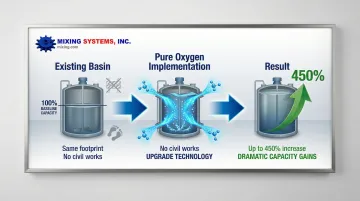
Pure oxygen systems can expand capacity of overloaded aeration basins by up to 450% within existing footprints—making them ideal for space-limited facilities.
Scenario 3: Aging Equipment and Maintenance Burdens
Aging systems create escalating maintenance costs through frequent blower failures, diffuser clogging that reduces oxygen transfer, and replacement parts that become difficult to source.
Modern pure oxygen delivery integrated with jet aeration systems eliminates in-basin moving parts. Mixing Systems' jet aerators place all mechanical assemblies outside tanks for easy service, reducing maintenance demands significantly compared to aging mechanical aerators.
Scenario 4: Seasonal Temperature Challenges
Summer heat creates compounding problems: oxygen solubility drops as water temperature rises, while bacterial metabolism accelerates and increases oxygen demand. This combination rapidly depletes DO, particularly in secondary clarifiers.
Facilities in warmer climates or those experiencing thermal stratification benefit from enhanced oxygen delivery that maintains DO levels during peak temperature periods.
Scenario 5: Peak Loading from Seasonal or Industrial Variations
| Loading Source | Typical Impact |
|---|---|
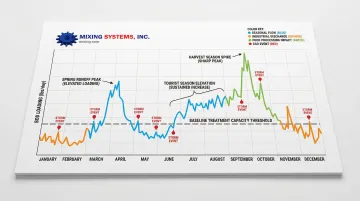
| Seasonal flow variations | Spring runoff, tourist seasons double influent |
| Industrial discharge spikes | Production cycles create BOD surges |
| Food processing operations | Harvest seasons triple organic loading |
| Combined sewer overflow | Storm events overwhelm hydraulic capacity |
Enhanced aeration systems excel at managing these peak conditions, maintaining treatment performance when conventional systems would fail to keep pace with sudden demand increases.
How Pure Oxygen Transforms Treatment Efficiency
Superior Dissolved Oxygen Levels and Treatment Capacity
Pure oxygen systems maintain high DO concentrations (>10 mg/L) in wastewater, which accelerates degradation rates and enables facilities to handle significantly higher organic loading within the same basin volume.
The capacity advantage stems from:
- Pure oxygen systems dissolve 70-90% of supplied oxygen versus 15% for air systems
- Higher saturation limits enable rapid oxygen uptake by biomass
- More complete oxidation of organics to CO2
- Ability to maintain DO during peak loading events
These elevated DO levels translate directly to treatment capacity gains. Facilities can process higher organic loads in the same footprint, eliminating the need for costly basin expansion.
Improved Mixing and Dead Zone Elimination
Advanced jet aeration systems create strong turbulent flow that dissolves oxygen efficiently while ensuring mixing reaches all areas of aeration tanks.
Horizontal plume injection technology offers distinct advantages:
- Creates longer gas/liquid transfer interface compared to vertical bubble rise
- Maintains contact time for superior mass transfer
- Eliminates stagnant zones where DO drops to zero
- Maximizes effective reactor volume utilization
Systems designed with horizontal plume injection and no in-basin moving parts deliver superior transfer rates while minimizing maintenance requirements.
Enhanced Sludge Settling and Floc Formation
The improved oxygen delivery affects sludge quality as much as treatment capacity. Pure oxygen aeration produces measurable improvements in sludge characteristics:
- Well-developed sludge flocs form within just 14 days of implementation
- Sludge Volume Index (SVI) optimizes at MLVSS levels of approximately 3,600-3,800 mg/L
- Higher DO levels prevent filamentous bacteria growth that causes bulking
- More complete oxidation reduces overall sludge generation
The improved settling allows thicker clarifier underflow, reducing the volume of liquid sludge requiring handling and disposal.
Minimized VOC Stripping and Odor Control
Beyond operational improvements, pure oxygen systems deliver environmental benefits. Covered tank configurations dramatically reduce emissions:
- More than 90% reduction in volatile organic compound stripping compared to air systems
- Drastically lower gas flow rates keep VOCs in the liquid phase for biodegradation
- Extended residence time allows nearly 100% degradation of volatile but biodegradable compounds
- Reduced off-gas volume simplifies odor management and control systems
Energy Consumption Advantages
Pure oxygen systems require energy for oxygen generation, yet they deliver net energy savings through superior efficiency:
Documented performance:
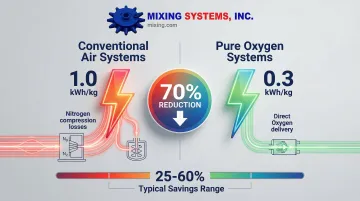
- 50-70% reduction in specific energy consumption versus air systems
- Power-related cost reductions of approximately 25%
- Some advanced systems consume just 0.3 kWh per kg of oxygen dissolved versus 1 kWh/kg for conventional aeration
The efficiency gains stem from eliminating the energy waste of compressing and moving nitrogen through the system—nitrogen that provides no treatment benefit.
System Components and Design Considerations
Cryogenic Bulk Storage Tanks
Pure oxygen systems rely on cryogenic bulk storage tanks designed for safety and efficiency. These double-walled, vacuum-insulated vessels minimize heat transfer while storing liquid oxygen at extremely low temperatures.
Key specifications:
- Capacity ranges from 500 to 420,000 gallons (1,893-1,589,873 liters)
- Equipped with circuits for filling, pressure buildup, relief, and product withdrawal
- Diking systems contain entire tank contents if rupture occurs
Safety systems include low-temperature alarms (typically triggering at -10°F, shutting down at -20°F), pressure relief valves, emergency venting, and oxygen-compatible materials throughout. Single-point venting simplifies exhaust gas management.
Ambient Air Vaporizers and Control Systems
Vaporizers convert liquid oxygen (LOX) into gaseous state for injection into treatment basins. Pressure control manifolds regulate gas pressure fed to the application, ensuring consistent delivery rates matched to biological demand.
Modern control panels provide critical functionality for safe, efficient operation:
- Flow rate adjustment based on real-time DO monitoring
- Automatic shutdown systems for safety
- Integration with existing SCADA systems
- Demand-based operation that minimizes oxygen waste
Oxygen Injection Methods
Facilities can choose from several injection technologies, each suited to different operational requirements.
Spargers and diffusers offer the simplest approach—porous tubes or plates with lower capital costs and moderate transfer efficiency. They work well in shallow basins but require more oxygen to achieve target DO levels.
Porous hoses provide flexible installation with even distribution along basin length. When clogging occurs, replacement is straightforward, making them ideal for retrofit applications.
Jet aeration systems deliver superior oxygen transfer rates through directional injection. These systems create horizontal plumes that extend gas-liquid contact time significantly beyond conventional diffused air methods. All mechanical assemblies mount externally for easy service access, and optional pneumatic backflush prevents clogging without system shutdown.
Jet aerators combine high transfer efficiency with low maintenance requirements, positioning them as a proven solution for facilities prioritizing long-term operational costs over initial capital investment.
Basin Configuration Options
Choosing between direct injection and side-stream configurations depends on your basin characteristics and treatment objectives.
Direct injection introduces oxygen directly into the main aeration basin—the simplest installation approach. This method works best for complete-mix designs with adequate hydraulic mixing to distribute oxygen throughout the basin volume.
Side-stream injection dissolves oxygen in a high-velocity side stream before returning the oxygenated flow to the main basin. This approach enables very high DO concentrations and protects the main basin from operational disruptions during system adjustments.
The optimal configuration depends on basin geometry and volume, existing hydraulic patterns, desired DO profile, space constraints, and how well the system integrates with existing infrastructure.
System Sizing Based on Oxygen Demand
Proper system sizing requires a methodical approach:
- Determine BOD/COD loading from influent characteristics and flow rates
- Calculate stoichiometric oxygen demand for biomass synthesis and endogenous respiration
- Apply alpha and beta correction factors for wastewater characteristics and temperature
- Add safety factor for peak loading conditions
Design parameters for domestic wastewater (≤200 mg/L BOD5):
- Nominal detention time: 1.4-2.0 hours (significantly shorter than air systems)
- Target MLVSS: Approximately 3,500 mg/L
- DO profile: 10 mg/L in first stage, tapering to 2 mg/L in final stages
Pilot-plant data provides the most reliable source for determining specific design parameters for industrial or high-strength wastewaters.

Implementation and Integration Strategies
Pure oxygen systems integrate into existing operations with minimal disruption, offering flexibility that conventional expansion projects cannot match.
Integration Without Process Interruption
Advanced jet aeration systems allow installation without shutting down treatment processes:
- Equipment mounts externally with piping connections to existing basins
- Step-by-step startup enables gradual transition
- Existing air systems remain operational during installation
- No major civil works or basin reconstruction required
Evaluation Process for Optimal Configuration
Before installation, a systematic assessment ensures optimal system configuration.
Assessment steps include:
- DO profiling throughout existing basins to identify deficient zones
- Hydraulic analysis to determine optimal injection points
- Demand calculation based on current and projected loading
- Pilot testing (when needed) to validate design assumptions
- Integration planning with existing control systems
Typical Implementation Timeline
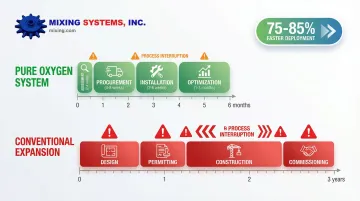
Once evaluation is complete, implementation proceeds significantly faster than conventional capacity expansion.
Historical case studies show facilities converting from air to pure oxygen in less than 12 months from project start to full optimization. For emergency capacity needs, systems can be installed and operational within weeks.
Timeline phases:
- Initial assessment and design: 2-4 weeks
- Equipment procurement: 4-8 weeks
- Installation and commissioning: 2-6 weeks
- Optimization period: 1-3 months
The compressed timeline compared to civil construction projects (which often require 2-3 years) makes pure oxygen particularly attractive for facilities facing immediate compliance deadlines or capacity constraints.
Cost-Benefit Analysis and ROI
Capital Cost Components
Cryogenic storage approach requires substantial upfront investment across multiple components:
- LOX storage tank: Approximately $2.4 million (including shipping and 5-year maintenance contract)
- Site work (grading, foundations, electrical): Approximately $2.1 million
- Vaporizer and control systems: Included in tank package or separate procurement
- Injection equipment: Varies by technology and basin configuration
On-site generation approach offers independence from external suppliers but demands higher capital investment:
- VPSA oxygen generator (59 TPD): Approximately $26.2 million
- Cryogenic generator (59 TPD): Approximately $27.6 million
- Higher capital cost but eliminates ongoing oxygen supply expenses
- Economic at larger facilities with consistent high demand
Injection system costs:
- Jet aeration systems: Moderate capital cost, low maintenance
- Spargers and diffusers: Lower capital cost, higher maintenance
- Control systems and monitoring: $50,000-$200,000 depending on sophistication
Operating Cost Comparison
Pure oxygen systems deliver significant operational advantages over conventional air-based aeration:
- 50-70% reduction in specific energy consumption versus air systems
- Energy savings of 25-60% in documented installations
- Reduced sludge handling costs from improved settling characteristics
- Lower maintenance requirements with no in-basin moving parts
These efficiency gains translate into tangible cost benefits. Avoided expenses include capital expenditure for blower upgrades or basin expansion, smaller electrical service requirements, and reduced footprint eliminating additional blower buildings. Faster implementation also reduces financing costs.
ROI Factors and Timeframes
Projects implementing automated dissolved oxygen (DO) control strategies—a core feature of pure oxygen systems—typically achieve simple payback in 18-30 months.
ROI drivers include:
- Energy savings: $50,000-$500,000+ annually from 25-60% power reductions, depending on facility size
- Avoided capital costs: Eliminating need for $5-$20 million basin expansion projects
- Permit compliance value: Avoiding fines and maintaining discharge authorization
- Increased capacity: Monetizing additional treatment capacity for new connections or industrial customers
Optimal facility profiles for pure oxygen adoption:
- Municipal facilities treating 4-6 MGD (million gallons per day) or more
- Industrial facilities with high-strength waste streams
- Operations where conventional systems would require basin expansion
- Sites with space constraints limiting conventional infrastructure
Frequently Asked Questions
How does pure oxygen aeration compare to traditional air systems in terms of total cost of ownership?
Pure oxygen systems have higher oxygen supply costs but deliver 25-60% lower power requirements and reduced maintenance expenses. Total cost of ownership often favors pure oxygen due to avoided capital expenditure for capacity expansion and increased treatment capacity within existing footprints.
Can pure oxygen systems be used as a temporary solution or must they be permanent installations?
Pure oxygen systems work for both emergency supplementation and permanent capacity enhancement. Mobile systems deploy rapidly for equipment failures or seasonal peaks, while permanent installations provide long-term efficiency improvements.
What safety considerations are involved with storing and using pure oxygen on-site?
Safety is governed by NFPA 55 (2023 Edition) and OSHA 29 CFR 1910.101 standards. Modern systems include automatic temperature monitoring, pressure relief valves, spill containment diking, and oxygen-compatible materials throughout. Single-point venting simplifies exhaust gas management and reduces safety monitoring complexity.
How quickly can a pure oxygen system be deployed when treatment capacity issues arise?
Deployment timeframes range from weeks for emergency installations to 3-6 months for planned permanent systems. This represents a dramatic acceleration compared to conventional capacity expansion projects requiring 2-3 years of design, permitting, and construction.
Does pure oxygen aeration work for all types of wastewater or only specific applications?
Pure oxygen treatment is highly versatile, effectively treating municipal wastewater as well as high-strength industrial waste from food processing, pharmaceuticals, petrochemicals, and pulp and paper operations. The technology performs optimally where oxygen demand exceeds conventional system capacity or where space and power constraints limit traditional expansion options.
What performance metrics should facilities monitor when using pure oxygen aeration?
Monitor dissolved oxygen levels (1.5-2.0 mg/L minimum), BOD/COD removal rates (>95%), sludge volume index, and energy consumption per pound of oxygen transferred. Real-time DO monitoring enables demand-based oxygen delivery for optimal efficiency.
About Mixing Systems, Inc.
Since 1985, Mixing Systems has specialized in engineered jet aeration and jet mixing systems for industrial and municipal wastewater treatment. With hundreds of installations serving major clients including BASF, Dow Chemical, Pfizer, Cargill, and Anheuser Busch, the company delivers custom-designed solutions with energy savings up to 40%. Mixing Systems' jet aerators use horizontal plume injection technology with no in-basin moving parts for minimal maintenance requirements. For more information about jet aeration systems for pure oxygen applications, contact Mixing Systems at 937-435-7227 or mixing@mixing.com.