Introduction
Aeration basins are the primary biological treatment stage where contaminated water is converted into clean effluent. These infrastructure components serve municipal and industrial facilities worldwide, treating billions of gallons of wastewater daily through carefully controlled biological processes.
The stakes are high: aeration systems typically consume 45-75% of a wastewater treatment plant's total electrical energy, making operational efficiency both an environmental and financial imperative.
Poor aeration performance can lead to permit violations, odor complaints, and skyrocketing energy costs.
This article covers what aeration basins are, how they work biologically, the major aeration system types available, and practical operating parameters that ensure compliance while controlling costs.
TLDR: Key Takeaways About Aeration Basins
- Aeration basins use oxygen to support aerobic microorganisms that consume organic pollutants
- Microbes convert waste into carbon dioxide, water, and biomass through controlled biological respiration
- Jet aeration systems deliver high oxygen transfer efficiency with lower maintenance than diffused air
- Optimal dissolved oxygen levels (1.5-3.0 mg/L) balance treatment quality and energy use
- Automated controls cut energy consumption by 10-30%
What is an Aeration Basin?
An aeration basin is a tank where oxygen is introduced to wastewater to support aerobic biological treatment processes. These basins are the cornerstone of the activated sludge process—the most common secondary wastewater treatment method used globally.
Dual Purpose Design
Aeration basins serve two critical functions:
- Oxygen delivery: Introducing air to support microbial respiration and pollutant consumption
- Mixing action: Keeping biomass suspended and in continuous contact with organic pollutants
These functions must work together effectively regardless of system scale.
Scale and Energy Profile
Aeration basins range dramatically in size, from small industrial treatment systems processing thousands of gallons per day to massive municipal facilities handling hundreds of millions of gallons daily. Yet aeration typically accounts for 45-75% of a plant's total energy consumption, making system efficiency critical to operational budgets.
This creates a strong financial reason for optimization. Consider this: a facility operating at 4 mg/L dissolved oxygen when 2 mg/L would suffice wastes substantial energy without improving treatment performance.
How Aeration Basins Work: The Biological Process
The activated sludge process relies on growing a diverse population of aerobic microorganisms—bacteria, protozoa, and fungi—that consume organic pollutants as their food source.
The Biological Cycle
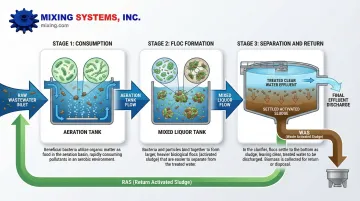
Step 1: Consumption
Wastewater enters the basin where microorganisms use dissolved oxygen to metabolize organic matter through aerobic respiration. This biological oxidation converts pollutants into CO₂, water, and new cell mass (biomass).
Carbon removal typically requires 0.9-1.3 lb O₂ per lb BOD removed.
Step 2: Floc Formation
Microorganisms naturally clump together with organic particles, forming "floc"—visible clusters that make biomass separation much easier in downstream clarifiers.
Step 3: Separation and Return
Treated water flows to secondary clarifiers where biomass settles by gravity. A portion of this settled sludge (Return Activated Sludge or RAS) returns to the aeration basin to maintain the microbial population, while excess sludge (Waste Activated Sludge or WAS) is removed.
Critical Process Ratios
Operators monitor two key parameters to maintain optimal biological activity:
Food-to-Microorganism (F/M) Ratio
This ratio balances incoming organic load against the mass of microbes in the basin.
- High F/M: Promotes rapid growth but can cause poor settling
- Low F/M (extended aeration): Produces stable sludge but requires larger tank volumes
Solids Retention Time (SRT)
Also called sludge age, SRT defines how long biomass remains in the system. Nitrification requires SRT of 10-20 days at 10°C and 4-7 days at 20°C because nitrifying bacteria grow slowly compared to organisms that consume carbon.
Types of Aeration Systems
Selecting the right aeration technology involves balancing capital costs, maintenance requirements, and energy efficiency.
Fine-Bubble Diffused Aeration
Fine-bubble systems use porous membranes or ceramic discs installed at the basin floor to release tiny bubbles (0.04-0.1 inches in diameter).
Performance characteristics include:
- Up to 4x higher oxygen transfer efficiency than coarse bubble systems
- Ideal for high-efficiency carbon removal and nitrification
Fine-bubble diffusers are prone to fouling from biofilm and mineral deposits, requiring regular cleaning to maintain performance. Rising blower discharge pressure typically signals diffuser fouling.
Coarse-Bubble Diffused Aeration
Coarse-bubble systems release larger bubbles (0.2-0.5 inches) with lower oxygen transfer efficiency but better mixing capability.
Common applications include:
- Sludge holding tanks and channel aeration
- Basins where mixing takes priority over oxygen transfer
- High-load systems requiring robust operation
These systems offer lower maintenance requirements and less susceptibility to fouling compared to fine-bubble systems.
Mechanical Surface Aerators
Motor-driven devices churn water at the surface, mixing air into the liquid through turbulence.
Performance metrics include:
- Achieve 80-90% BOD removal with retention times of 1-10 days
Best suited for oxidation ditches, lagoons, and facilities prioritizing operational simplicity over maximum energy efficiency.
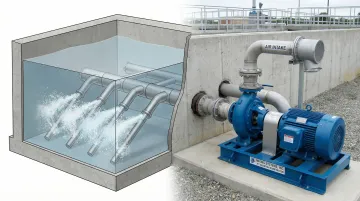
Jet Aeration Systems
Beyond conventional diffused air and mechanical systems, jet aeration uses high-velocity water jets to draw in and mix air into wastewater through submerged nozzles.
Key advantages include:
- No in-basin moving parts—all mechanical assemblies located outside tanks for easy service access
- Multiple oxygen transfer zones create superior mass transfer rates
- Suitable for deep tank applications where diffused air faces pressure limitations
- Eliminates mist and spray problems common with surface aerators
Mixing Systems, Inc. has pioneered jet aeration technology with systems that achieve energy reductions of up to 40% over conventional methods through superior oxygen transfer efficiency.
Their systems feature optional pneumatic backflush capabilities to prevent clogging, delivering virtually maintenance-free operation compared to diffuser-based systems.
Critical Operating Parameters to Monitor
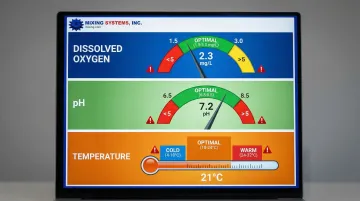
Maintaining optimal conditions in your aeration basin directly impacts treatment efficiency, compliance, and energy costs. These three parameters require continuous monitoring.
Dissolved Oxygen (DO)
Target range: 1.5-3.0 mg/L for most applications
- Carbon removal only: 1.0-2.0 mg/L is typically sufficient
- Nitrification: Requires 2.0 mg/L or higher for optimal performance
- Energy penalty: Operating at 4 mg/L instead of 2 mg/L wastes substantial energy without improving treatment
Monitoring strategy:
Install multiple measurement points throughout the basin to capture variations, especially near the influent where oxygen demand peaks. Automated DO control prevents over-aeration during low-loading periods and can reduce energy consumption by 10-30%.
pH Level
Optimal range: 6.5-8.5 for general treatment; 7.5-8.5 for nitrification
Outside this range, microbial activity decreases significantly. Key pH effects include:
- Low pH (<6.5) may promote fungal growth and bulking
- High pH can cause ammonia toxicity to biomass
- Nitrification consumes approximately 7.14 g of alkalinity (as CaCO₃) per gram of ammonia oxidized
- Insufficient alkalinity leads to pH crashes that inhibit biological activity
Temperature
Biological activity increases with temperature between 0-40°C, with most systems operating in the 4-32°C range.
Critical temperature considerations:
- Nitrification rates may drop by half for every 8-10°C temperature reduction
- Basin volume and SRT must be sized for coldest expected winter temperatures
- Sudden temperature changes can shock biomass populations, causing temporary upsets
Operation and Maintenance Best Practices
Reliable aeration basin performance depends on three operational pillars: real-time process control, systematic equipment maintenance, and precise biomass management.
Real-Time Optimization
Modern aeration systems adjust oxygen delivery dynamically based on actual basin conditions rather than fixed schedules.
Key optimization strategies include:
- Continuous DO monitoring across multiple basin zones to identify oxygen demand patterns
- Variable frequency drives (VFDs) on blowers to match air supply precisely to biological demand
- Automated adjustments for influent loading fluctuations (peak hours, seasonal variations)
- Real-time data logging to identify energy waste from over-aeration
This approach cuts energy consumption significantly. Facilities using VFD-controlled jet aeration systems from companies like Mixing Systems, Inc. have reported energy reductions of up to 40% compared to constant-speed mechanical aerators.
Equipment Maintenance Schedule
Daily:
- Visual inspection of aeration equipment operation
- Check for unusual foaming, odors, or surface conditions
- Monitor DO readings across multiple basin zones
Monthly:
- Performance checks of blowers and mechanical equipment
- Verify DO probe calibration
- Inspect for diffuser clogging indicators (rising backpressure)
Annually:
- Comprehensive maintenance including diffuser cleaning or replacement
- Mechanical component servicing
- Full system performance testing
Biomass Management
Proper biomass control prevents common treatment failures.
Maintain optimal sludge age through controlled wasting of excess biomass. This prevents filamentous bulking and nutrient deficiencies when concentrations drift outside design parameters. Target MLSS (mixed liquor suspended solids) levels typically range from 2,000-4,000 mg/L for conventional activated sludge systems, adjusted based on your specific loading conditions.
Frequently Asked Questions
What is the purpose of the aeration basin?
The aeration basin supplies oxygen to support aerobic microorganisms that consume organic pollutants, converting wastewater into clean water and biomass. It also provides mixing to keep biomass suspended and in contact with contaminants.
How long does wastewater stay in an aeration basin?
Retention time ranges from 3-8 hours for conventional activated sludge to 18-36 hours for extended aeration systems. Duration depends on treatment objectives, influent characteristics, and nitrification requirements.
What is the ideal dissolved oxygen level in an aeration basin?
Most systems target 1.5-3.0 mg/L DO. Higher levels (2.0+ mg/L) are needed for nitrification, while lower levels (1.0-2.0 mg/L) are acceptable for carbon removal only. Excessive DO wastes energy without improving treatment.
What causes foaming in aeration basins?
Common causes include nutrient deficiency, surfactants/detergents in the influent, filamentous bacteria overgrowth (especially Nocardia), or young sludge age. Control methods include reducing sludge retention time, removing grease at the headworks, or surface chlorine spraying.
How often should aeration equipment be maintained?
Daily visual inspections are essential, with monthly checks of blowers and DO systems. Annual maintenance should include mechanical component servicing and performance testing. Jet aeration systems with external mechanical assemblies typically require less maintenance than submerged equipment.
What are the signs of poor aeration basin performance?
Key indicators include high effluent BOD/COD levels, poor settling sludge with high SVI, persistent foaming, odors (especially hydrogen sulfide), and fluctuating DO levels despite adequate aeration capacity. These symptoms signal biological imbalances requiring corrective action.