Introduction
Aeration represents the single largest operational expense in wastewater treatment plants, typically consuming 50-60% of total energy costs. For facilities treating millions of gallons daily, this translates to hundreds of thousands of dollars annually.
Inefficient aeration creates a cascade of problems: poor treatment performance, regulatory violations, and strained operating budgets. Insufficient oxygen leads to bacterial die-off and effluent quality failures, while excessive aeration wastes energy without improving outcomes.
This article examines the science behind activated sludge aeration and practical strategies for optimization. You'll learn:
- How different aeration technologies compare in performance and efficiency
- Key factors that affect oxygen transfer and treatment outcomes
- Proven approaches for reducing energy costs while maintaining quality
Key Takeaways
- Aeration supplies dissolved oxygen to aerobic bacteria that metabolize organic pollutants in wastewater
- DO levels of 1.5-3.0 mg/L prevent sludge bulking and optimize treatment efficiency
- Jet aeration systems reduce energy consumption by up to 40% vs. conventional methods
- Equipment selection and control strategies directly impact treatment quality and costs
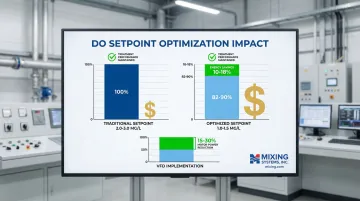
- Proper maintenance and DO setpoint optimization can reduce energy consumption by 10-30%
What Is Activated Sludge Aeration?
Activated sludge aeration introduces oxygen into wastewater mixed with microorganisms (activated sludge) to support aerobic biological treatment. The fundamental outcome is straightforward: oxygen enables bacteria and other microorganisms to metabolize organic matter—measured as BOD (Biochemical Oxygen Demand) or COD (Chemical Oxygen Demand)—converting it into carbon dioxide, water, and new cell mass.
While mixing keeps solids suspended, aeration specifically focuses on oxygen transfer and dissolution. This distinction matters because the efficiency of oxygen transfer directly impacts energy consumption and treatment performance.
The aeration process must balance several operational factors:
- Oxygen dissolution rate – How quickly air transfers into the liquid phase
- Dissolved oxygen levels – Maintaining 1.5-4.0 mg/L for optimal bacterial activity
- Energy efficiency – Avoiding excessive aeration that wastes power
- Mixing intensity – Keeping biomass suspended without damaging microbial flocs
Different aeration technologies—from diffused air systems to submerged jet aerators—achieve these goals through varying mechanisms. The choice of system affects both oxygen transfer efficiency and operational costs, with energy-efficient designs reducing power consumption by up to 40% compared to conventional methods.
Why Aeration Is Critical in Activated Sludge Treatment
Aerobic bacteria require minimum dissolved oxygen levels of 0.5-1.0 mg/L to survive. Optimal treatment occurs at 1.5-3.0 mg/L DO. Below these thresholds, bacterial populations decline rapidly and treatment performance collapses.
This leads to multiple cascading failures:
- Bacteria die off and organic matter accumulates untreated
- Anaerobic conditions develop, producing hydrogen sulfide and other odorous compounds
- Filamentous bacteria multiply rapidly, causing sludge bulking and poor settling
- Effluent quality violations trigger regulatory penalties and potential discharge restrictions
Proper aeration serves dual purposes: meeting regulatory discharge permits (typically BOD <10-20 mg/L, TSS <15-30 mg/L) and maintaining stable biological populations that prevent system upsets. For plants with nutrient removal requirements, aeration demands increase significantly—nitrification alone requires 4.6 lb O2/lb NH3-N oxidized.
Key oxygen requirement thresholds:
- Minimum survival: 0.5-1.0 mg/L DO
- Optimal treatment: 1.5-3.0 mg/L DO
- Nitrification demand: 4.6 lb O2 per lb NH3-N oxidized
How the Activated Sludge Aeration Process Works
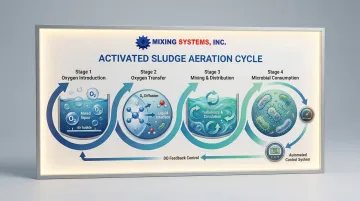
The aeration process involves three interconnected mechanisms: oxygen introduction, transfer, and consumption.
Oxygen Introduction and Transfer:
Aeration equipment introduces air or oxygen into the basin containing mixed liquor (wastewater plus activated sludge). As air bubbles rise through the liquid, oxygen molecules diffuse across the bubble-liquid interface based on concentration gradients.
Smaller bubbles and longer contact time dramatically increase transfer efficiency—fine bubbles (0.7-1.0 mm) rise slower and provide greater surface area per volume of air than coarse bubbles (>3 mm).
Mixing and Distribution:
Aeration equipment creates turbulence that distributes oxygen throughout the basin, prevents solids settling, and ensures all microorganisms access both oxygen and organic substrate. Without adequate mixing, dead zones form where bacteria lack oxygen or food, cutting overall treatment efficiency.
Oxygen Consumption:
Microorganisms consume oxygen at rates proportional to organic loading and biomass concentration—a metric called Oxygen Uptake Rate (OUR).
Key consumption factors:
- Aeration systems must continuously replenish dissolved oxygen to match microbial consumption
- At typical MLSS concentrations of 3,000-5,000 mg/L, oxygen demand fluctuates with influent characteristics
- Responsive control systems are required to adjust to changing demand
Real-Time Control:
Modern systems use dissolved oxygen sensors to monitor DO levels continuously. Controllers adjust blower speed or aerator operation to maintain setpoints, optimizing treatment while minimizing energy waste. This feedback loop is essential—automated DO control systems can save 10-30% of total energy costs compared to fixed-speed operation.
Types of Aeration Equipment Used in Activated Sludge Systems
Equipment selection fundamentally determines energy efficiency and operating costs. Three primary technologies dominate the market, each with distinct performance characteristics.
Fine-Bubble Diffused Aeration
Air blown through submerged diffusers creates bubbles that transfer oxygen as they rise. Fine-bubble diffusers (producing 1-3 mm bubbles) achieve 20-30% oxygen transfer efficiency, delivering approximately 5.0-6.5 kg O2/kWh under standard conditions. Field performance typically ranges from 2.5-3.5 kg O2/kWh due to wastewater characteristics and temperature effects.
This approach delivers the highest oxygen transfer efficiency among conventional technologies, requiring 30-40% less air than coarse-bubble systems for equivalent DO levels. Deep basins (4-6 meters) work particularly well, as pressure increases efficiency.
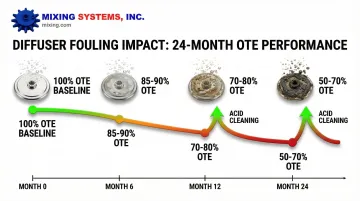
The tradeoff? Diffuser fouling reduces OTE by 30-50% over 1-2 years, requiring periodic cleaning or replacement.
Mechanical Surface Aerators
In contrast to submerged diffusion, mechanical surface aerators use rotating impellers at the water surface to create spray and turbulence, drawing air into the liquid. Common in oxidation ditches and smaller plants, these systems achieve 1.2-2.0 kg O2/kWh under field conditions.
Simple installation with no submerged air distribution piping makes these systems attractive for retrofit applications. Operators can visually inspect operation, and the systems work effectively in shallow basins where diffused aeration is impractical.
However, lower oxygen transfer efficiency results in higher energy consumption per pound of oxygen delivered.
Jet Aeration Systems
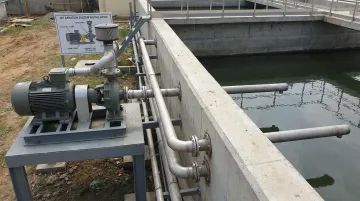
A third approach uses high-velocity liquid jets to draw in and shear air into fine bubbles within mixing chambers. Mixing Systems, Inc. pioneered this technology, which places all mechanical components outside the basin for easy maintenance.
Jet aeration systems can achieve energy savings of up to 40% over conventional methods through superior oxygen transfer efficiency.
The design offers several operational advantages:
- All mechanical assemblies remain accessible outside tanks, eliminating basin dewatering during maintenance
- Horizontal plume injection maintains gas/liquid interface longer than vertical bubble rise
- Deep tank operation without the fouling issues that plague submerged diffusers
- Optional pneumatic backflush systems prevent clogging
Selection criteria depend on basin depth, wastewater characteristics, existing infrastructure, maintenance capabilities, and capital versus operating cost tradeoffs. While fine-bubble diffusers offer excellent efficiency in new installations, jet aeration provides compelling advantages in retrofit applications and facilities prioritizing maintenance accessibility.
Key Factors That Affect Aeration Performance in Activated Sludge Systems
Actual aeration performance differs significantly from manufacturers' clean-water specifications. Multiple interacting variables affect efficiency in working treatment systems.
Oxygen Transfer Efficiency Variables
The alpha factor (α) represents the ratio of oxygen transfer in wastewater versus clean water. Typical values range from 0.4-0.8 for diffused aeration, meaning actual oxygen transfer is 40-80% of what manufacturers specify for clean water. Surfactants, salinity, and suspended solids all reduce α by creating interfacial barriers that impede oxygen diffusion.
Temperature creates a trade-off: cold water holds more oxygen but transfers it slowly, while warm water saturates faster at lower DO levels.
Organic Loading and MLSS Concentration
BOD loading directly drives oxygen demand. Higher organic loads require proportionally more aeration capacity.
MLSS concentration (typical range: 3,000-5,000 mg/L) affects oxygen requirements throughout floc structures. When MLSS exceeds 6,000 mg/L, viscosity increases and the alpha factor drops significantly—sometimes requiring 50% more air to achieve the same DO levels.
Basin Configuration and Hydraulics
Tank geometry, depth, and flow patterns significantly impact aeration effectiveness:
- Depth advantage: Oxygen transfer efficiency increases approximately 2% per foot of submergence due to longer bubble contact time and higher partial pressure
- Dead zones: Poor mixing creates areas where bacteria are oxygen-starved despite adequate average DO
- Short-circuiting: Hydraulic pathways that bypass portions of the basin reduce effective treatment volume
Diffuser Fouling and Maintenance
Biological growth, mineral scaling, and grease accumulation reduce oxygen transfer efficiency by 30-50% over time.
Regular acid cleaning restores 70-80% of lost OTE, but membrane diffusers typically require replacement every 8-12 years to maintain performance.
Control Strategy and Automation
DO setpoint selection and blower control methods directly impact both treatment quality and energy consumption:
- DO setpoint optimization: Reducing setpoints from 2.0 mg/L to 1.0-1.5 mg/L cuts energy consumption by 10-18% while maintaining treatment performance
- Variable frequency drives (VFDs): VFD-controlled blowers reduce motor power by 15-30% and enable precise load matching
- Advanced control: Ammonia-based aeration control (ABAC) provides air only when nitrification demand exists, preventing over-aeration
For plants with biological nutrient removal, excessive DO (>4 mg/L) in aerobic zones disrupts denitrification. High-DO mixed liquor recirculated to anoxic zones interferes with nitrate reduction, which requires low-oxygen conditions.
Common Aeration Issues and Misconceptions
"More Aeration Is Always Better"
This misconception drives significant energy waste. Excessive DO levels (>4 mg/L) provide no treatment benefit beyond what 2-3 mg/L delivers, yet energy consumption increases exponentially as DO approaches saturation.
In biological nutrient removal plants, over-aeration eliminates the anoxic zones needed for denitrification, actually impairing nitrogen removal.
Confusion Between OTR and OTE
Oxygen Transfer Rate (OTR) measures total oxygen delivered (kg O2/hour), while Oxygen Transfer Efficiency (OTE) measures the percentage of supplied oxygen that dissolves. OTE is the critical metric for energy efficiency—a system delivering high OTR through massive air volumes may have poor OTE, wasting energy on oxygen that never dissolves when comparing equipment and optimizing operations.
All Aeration Equipment Performs Equally
Oxygen transfer efficiency varies dramatically between technologies:
- Fine-bubble diffusers: 20-30% OTE
- Coarse-bubble systems: 4-8% OTE
- Mechanical surface aerators: Variable efficiency based on design
Proper equipment selection can reduce energy costs by 30-40%, making technology choice one of the highest-impact decisions in plant design and upgrades.
Frequently Asked Questions
What is aeration of activated sludge?
Aeration is the process of introducing and dissolving oxygen into wastewater containing activated sludge microorganisms. This enables aerobic bacteria to metabolize organic pollutants, converting BOD/COD into carbon dioxide, water, and new biomass while maintaining effective biological treatment.
What is the difference between AOR and SOR in aeration systems?
SOR (Standard Oxygen Requirement) represents oxygen needed under standard conditions (20°C, clean water, sea level), while AOR (Actual Oxygen Requirement) accounts for field conditions. AOR is typically 40-60% higher than SOR due to temperature, wastewater characteristics, and the alpha factor.
What dissolved oxygen level should be maintained in an activated sludge aeration basin?
Maintain 1.5-3.0 mg/L DO for conventional activated sludge systems. Minimum levels of 0.5 mg/L prevent anaerobic conditions, while levels above 4.0 mg/L waste energy without treatment benefit. Specific setpoints depend on organic loading, MLSS concentration, and whether nitrification is required.
How can I reduce energy costs for aeration in my treatment plant?
Key strategies include optimizing DO setpoints (1.5-2.0 mg/L vs. 3-4 mg/L), implementing VFD controls on blowers, maintaining diffusers regularly, and upgrading to high-efficiency equipment like jet aeration systems. Real-time DO monitoring with automated control eliminates manual adjustments and prevents over-aeration.
What causes low dissolved oxygen levels despite running aerators continuously?
Common causes include diffuser fouling reducing oxygen transfer efficiency, excessive organic loading overwhelming system capacity, high MLSS concentrations (>6,000 mg/L) increasing oxygen demand, or equipment undersizing. Testing OTE and comparing to design specifications identifies the root cause.
What is oxygen transfer efficiency and why does it matter?
OTE is the percentage of supplied oxygen that actually dissolves into wastewater—typically 15-30% for most systems. Higher OTE means less energy required to deliver the same oxygen, directly impacting operational costs. Improving OTE from 20% to 25% can save larger plants over $100,000 annually.