Introduction
Many wastewater treatment operators encounter confusion around the term "activated sludge digester"—often leading to miscommunication about equipment needs and process design. In practice, activated sludge refers to the biological treatment process that cleans wastewater, while digestion describes what happens to the waste sludge produced afterward.
These are two distinct operations: the activated sludge process treats incoming wastewater using microorganisms and aeration, then the resulting waste sludge undergoes anaerobic digestion for stabilization.
This article clarifies both processes—how activated sludge treatment works and what happens to the sludge it generates.
Written for:
- Wastewater treatment operators managing biological systems
- Municipal engineers designing or upgrading facilities
- Industrial facility managers evaluating treatment technologies
- Anyone responsible for compliance or system optimization
Key Takeaways
- Microorganisms and aeration remove 85-95% of organic pollutants from wastewater
- Treatment produces clean effluent and waste sludge requiring anaerobic digestion
- Success depends on dissolved oxygen >2.0 mg/L, proper sludge retention, and balanced microbial populations
- Aeration represents 30-70% of total plant energy costs
- Key challenges: filamentous bulking, foaming, and process upsets
What Is the Activated Sludge Process?
The activated sludge process is an aerobic biological treatment method where microorganisms consume organic pollutants in wastewater. The term "activated" refers to the living microbial community—bacteria, protozoa, and other organisms—that form flocculent particles capable of settling out of treated water.
Key distinctions:
- Activated sludge: Living biomass actively treating wastewater in the aeration tank
- Digested sludge: Stabilized end product after waste sludge undergoes anaerobic digestion
- Anaerobic digestion: Separate treatment step breaking down organic matter in oxygen-free conditions, producing biogas
These processes work together in modern treatment facilities. Activated sludge handles incoming wastewater, while anaerobic digestion stabilizes the excess biomass generated during treatment.
Why Activated Sludge Is Used in Wastewater Treatment
Activated sludge dominates secondary treatment because it delivers 85-95% removal of BOD, COD, and suspended solids according to PMC research. This level of performance meets stringent regulatory requirements and protects receiving waters from oxygen depletion and ecosystem damage.
Industry Applications
Industries with high organic loads or strict discharge requirements depend on activated sludge treatment:
- Food and beverage processing (high organic loads)
- Chemical manufacturing (complex organic compounds)
- Pharmaceutical production (strict discharge limits)
- Pulp and paper operations (high wastewater volumes)
Between 60-75% of pulp and paper mills use activated sludge for effluent treatment due to its reliability and consistent performance across varying load conditions.
Meeting Regulatory Standards
Performance and compliance work together to drive activated sludge adoption. The EPA mandates secondary treatment standards for municipal plants: 30-day averages of 30 mg/L for both BOD₅ and TSS, with pH maintained between 6.0 and 9.0 per EPA secondary treatment guidelines.
Inadequate treatment leads to permit violations, ecosystem damage, and financial penalties.
How the Activated Sludge Process Works
The process follows a specific sequence designed to grow microorganisms and separate treated water:
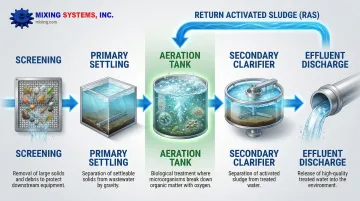
Screening → Primary Settling → Aeration Tank → Secondary Clarifier → Effluent Discharge
This sequence moves wastewater through distinct treatment zones. Screened wastewater enters the aeration tank along with return activated sludge (RAS) recycled from the clarifier, maintaining the microbial population needed for treatment.
Biological Oxidation Stage
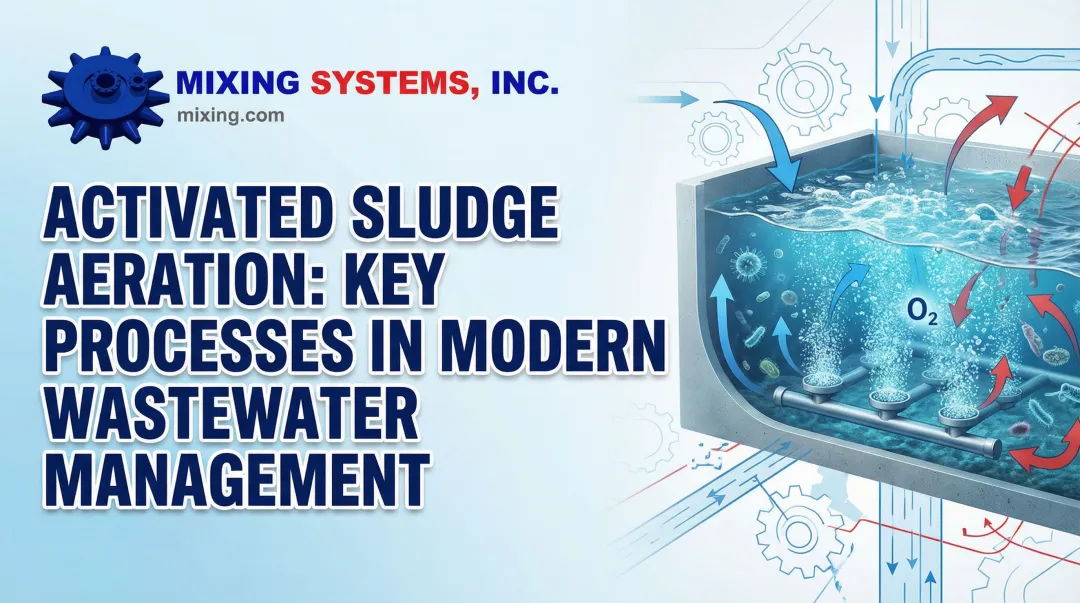
In the aeration tank, bacteria and protozoa consume organic matter and form flocs—clumps of microorganisms that settle easily. Dissolved oxygen (DO) enables aerobic metabolism, allowing microbes to break down BOD and convert it to carbon dioxide, water, and new cell mass.
Critical requirement: DO levels must stay above 2.0 mg/L according to EPA nutrient control design manual to support nitrification and prevent the growth of filamentous bacteria that cause settling problems.
Separation Stage
Once biological treatment is complete, separation begins. Mixed liquor (the combination of wastewater and activated sludge) flows to the secondary clarifier where biological flocs settle by gravity, producing two outputs:
- Clear treated water (overflow) that meets discharge standards
- Settled sludge (underflow) collected from the clarifier bottom
Sludge Recycling and Wasting
Proper sludge management balances biological activity with system capacity.
Return Activated Sludge (RAS): The majority of settled sludge returns to the aeration tank to maintain the microbial population. RAS rates typically range from 50-100% of influent flow, adjusted to maintain target MLSS concentrations.
Waste Activated Sludge (WAS): Excess sludge must be removed to prevent system overload and maintain proper food-to-microorganism ratios. Wasting controls the Solids Retention Time (SRT)—the average time biomass remains in the system.
SRT directly affects treatment efficiency and sludge characteristics.
Aeration Methods and Technologies
Aeration serves dual purposes: supplying oxygen for biological treatment and providing mixing to keep solids in suspension. Technology selection significantly impacts energy costs, as aeration systems consume 30-70% of total plant energy.
Diffused Air Aeration
Fine bubble diffusers installed at the tank bottom release small air bubbles that rise through the liquid. Key characteristics include:
- High oxygen transfer efficiency
- Most energy-efficient conventional option
- Prone to fouling requiring periodic cleaning or replacement
Surface Mechanical Aeration
Surface aerators—floating or fixed—splash and mix surface water to transfer oxygen. Common in oxidation ditches and lagoons, these units have distinct operational trade-offs:
- Lower oxygen transfer efficiency
- Simpler operation
- Create aerosols that can be problematic in cold climates
Jet Aeration Systems
Submerged jet aeration technology mixes compressed air and liquid through nozzles, creating high-velocity jets that generate micro-bubbles (very fine diameter).
Key advantages of jet aeration:
- Superior oxygen transfer efficiency through multiple transfer zones
- Energy savings up to 40% compared to conventional methods
- Effective mixing throughout tank depth, even in deep basins
- No moving parts in the tank, reducing maintenance requirements
- Horizontal plume injection maintains gas/liquid interface longer than vertical bubble diffusion
- Optional pneumatic backflush system eliminates clogging
These systems have been successfully deployed across chemical, pharmaceutical, food processing, pulp and paper, and municipal wastewater treatment facilities, with hundreds of installations operating globally.
Key Factors Affecting Process Performance
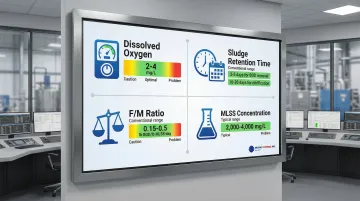
Treatment efficiency in activated sludge systems depends on maintaining several critical parameters within optimal ranges. Operators must monitor and control these factors to ensure consistent biological activity and effluent quality:
Oxygen and Hydraulic Parameters
Dissolved Oxygen (DO) Levels:
- Typical range: 2-4 mg/L in conventional systems
- Too low (< 2.0 mg/L): Causes poor treatment and promotes filamentous bacteria growth
- Too high (> 4.0 mg/L): Wastes energy without improving performance
Sludge Retention Time (SRT):
- BOD removal only: 3-5 days at 18-25°C
- Nitrification required: 10-20 days at 10°C, 4-7 days at 20°C
- Longer SRT produces less sludge but requires larger tanks
Loading and Biomass Ratios
Food-to-Microorganism (F/M) Ratio:
- Conventional range: 0.15-0.5 lb BOD/lb MLSS·day
- High F/M (0.4-1.5): High-rate processes with more sludge production
- Low F/M (0.05-0.15): Extended aeration with better settling but larger tanks
Mixed Liquor Suspended Solids (MLSS):
- Typical concentration: 2,000-4,000 mg/L
- Higher MLSS allows smaller tanks but increases clarifier loading
- Must balance with settling capacity
Chemical Balance Requirements
Nutrient Availability and pH:
- Microorganisms require BOD:N:P ratio of approximately 100:5:1
- Optimal pH range: 6.5-8.5 (nitrifiers prefer 6.8-8.0)
- Nitrification consumes alkalinity; insufficient alkalinity causes pH drops
Where the Activated Sludge Process Is Applied
Municipal wastewater treatment represents the most common application, treating domestic sewage from communities nationwide. It's the standard secondary treatment technology for publicly owned treatment works (POTWs) in the United States.
Beyond municipal facilities, activated sludge systems also handle complex industrial wastewater.
Industrial applications include:
- Food and beverage processing (breweries, dairies, meat processing)
- Chemical manufacturing (specialty chemicals, petrochemicals)
- Petroleum refining (process wastewater treatment)
- Pharmaceutical production (API manufacturing, formulation plants)
- Pulp and paper mills (kraft mill effluent, bleaching operations)
- Textile operations (dyeing, finishing processes)
Sludge Production and What Happens Next
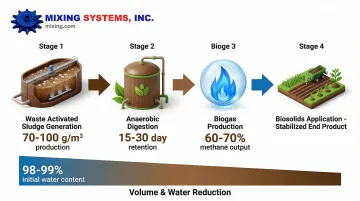
Activated sludge treatment produces 70-100 grams of waste activated sludge per cubic meter of wastewater treated.
Net solids yield typically ranges from 0.4-0.97 lb VSS/lb BOD removed, depending on temperature and SRT.
This waste activated sludge requires further treatment to:
- Reduce volume (sludge is 98-99% water initially)
- Stabilize organic matter (prevent odors and further decomposition)
- Eliminate pathogens (meet Class A or Class B biosolids standards)
Among these treatment goals, stabilization is most commonly achieved through anaerobic digestion.
In this process, waste sludge enters oxygen-free digesters where anaerobic bacteria break down organic matter over 15-30 days. The digestion produces:
- Biogas (60-70% methane) used for energy recovery
- Stabilized biosolids with reduced volatile solids and pathogens
Operators then dewater the digested sludge and apply it to land as fertilizer, compost it further, or dispose of it according to regulations.
Common Operational Challenges
Sludge Bulking
Excessive growth of filamentous bacteria prevents proper settling, indicated by Sludge Volume Index (SVI) exceeding 150 mL/g. Common causes include:
- Low dissolved oxygen (< 2.0 mg/L)
- Nutrient deficiency (nitrogen or phosphorus)
- Low F/M ratio (< 0.1)
- Septic conditions or sulfide presence
Operators must identify the specific filament through microscopic examination and adjust conditions accordingly.
Foaming Issues
Stable foam formation from surfactants, grease, or specific bacteria (Nocardia, Microthrix parvicella) can overflow tanks and create safety hazards. These organisms have hydrophobic cell walls that attach to air bubbles and float.
Control strategies include adjusting SRT, adding selector zones, or temporary chlorination. Proper aeration system design with adequate mixing prevents the stagnant zones where foam-forming bacteria thrive.
Process Upsets
Process upsets threaten microbial populations through several mechanisms:
- Toxic discharges from industrial sources
- Shock organic loads exceeding treatment capacity
- Temperature extremes disrupting biological activity
Recovery requires identifying the source, eliminating the upset condition, and potentially re-seeding with healthy biomass from another facility.
When Activated Sludge May Not Be the Best Choice
Activated sludge treatment delivers excellent results for many facilities, but it's not universally optimal. Understanding when simpler or alternative technologies make more sense helps you avoid unnecessary complexity and operating costs.
Simpler technologies suffice when:
- Flow rates are very small (< 10,000 gallons/day)
- Wastewater strength is low (< 200 mg/L BOD)
- Abundant land is available for lagoons or wetlands
- Regulatory requirements are less stringent
Even when activated sludge is theoretically appropriate, certain operational constraints can undermine its effectiveness:
Constraints reducing effectiveness:
- Highly variable flow or load patterns without equalization
- Lack of reliable electrical power supply
- Absence of skilled operators for daily monitoring
- Extremely cold climates without tank insulation
In these specific scenarios, alternative biological treatment approaches often deliver better performance and reliability:
Alternative processes preferred for:
- Trickling filters: Simpler operation, lower energy, suitable for small communities
- Membrane bioreactors: Tight space constraints, water reuse applications
- Anaerobic treatment: High-strength industrial waste (> 1,000 mg/L BOD), energy recovery potential
Conclusion
The activated sludge process remains the industry standard for biological wastewater treatment, delivering 85-95% removal of organic pollutants through controlled cultivation of microorganisms. Success depends on three critical factors:
- Understanding process biology and microbial cultivation requirements
- Maintaining operational parameters like dissolved oxygen (1.5-3.0 mg/L) and sludge retention time
- Selecting aeration technology that balances treatment effectiveness with energy efficiency
With aeration consuming up to 70% of plant energy, technology choices directly impact long-term operational expenses. Proper design and operation—including efficient aeration and mixing systems—ensures reliable treatment while minimizing costs. For example, submerged jet aeration systems can reduce energy consumption by up to 40% compared to conventional diffused air methods while maintaining thorough mixing and oxygen transfer.
Frequently Asked Questions
How does an activated sludge digester work?
"Activated sludge" treats wastewater using aerated microorganisms that consume organic pollutants, generating 70-100 grams of waste sludge per cubic meter. "Digester" refers to anaerobic vessels that stabilize this waste sludge through 15-30 days of digestion to reduce volume and pathogens.
What is the difference between digested sludge and activated sludge?
Activated sludge is living microbial biomass treating wastewater in aeration tanks at 2,000-4,000 mg/L concentration. Digested sludge is the stabilized end product after 15-30 days of anaerobic digestion, with reduced volatile solids and pathogens suitable for land application.
What is activated sludge used for?
Activated sludge treats municipal and industrial wastewater by using microorganisms to consume organic pollutants, producing clean effluent suitable for discharge or reuse. It removes 85-95% of BOD and suspended solids, meeting EPA secondary treatment standards of 30 mg/L for both parameters.
What are the main advantages of activated sludge over other treatment methods?
Key benefits include high treatment efficiency (85-95% BOD removal), compact footprint compared to lagoons, and ability to handle varying loads with proper control. It's the standard for meeting stringent discharge permits and supporting water reuse.
How much energy does an activated sludge system consume?
Aeration accounts for 30-70% of total plant energy use, making it the largest operational cost. Jet aeration systems can reduce energy consumption by 30-40% compared to conventional surface aerators, delivering significant long-term savings.
What causes activated sludge to not settle properly?
Poor settling results from filamentous bacteria overgrowth caused by low dissolved oxygen (< 2.0 mg/L), nutrient imbalance, low F/M ratio, or toxic substances. Sludge Volume Index exceeding 150 mL/g indicates bulking. Maintaining adequate DO, balanced nutrients, and appropriate F/M ratios prevents most settling problems.