Introduction
Sludge accumulation is one of the most critical operational challenges facing wastewater lagoon systems, directly threatening treatment capacity, regulatory compliance, and long-term viability.
While sludge buildup is inevitable in any lagoon system, proper aeration technology can dramatically slow accumulation rates, activate biological degradation of organic sludge, and in some cases even reduce existing sludge volumes.
The key distinction: aeration functions as a performance-defining parameter for sludge management, not simply an oxygen delivery method.
Non-aerated lagoons can accumulate sludge at rates exceeding 30 cm per year, forcing costly dredging operations every 5-10 years. Properly aerated systems, by contrast, can operate for 20-30 years without requiring mechanical sludge removal, transforming passive storage basins into active biological reactors.
Understanding how aeration influences sludge behavior—through mixing patterns, oxygen transfer characteristics, and biological activation—is essential for extending lagoon life, reducing maintenance costs, and maintaining compliance with discharge permits.
Key Takeaways
- Aeration delivers oxygen for treatment while actively reducing sludge through mixing and microbial digestion
- Proper aeration reduces organic sludge accumulation by 30-60% compared to non-aerated systems by promoting aerobic digestion
- Aeration technologies differ significantly in sludge control based on mixing patterns and oxygen transfer
- Understanding aeration's role in sludge control extends lagoon life and reduces dredging frequency
Understanding Aeration's Role in Lagoon Sludge Management
Aeration in wastewater lagoons functions as both an oxygen delivery mechanism and a physical mixing force that fundamentally influences sludge behavior. This dual role is often misunderstood, leading to systems that meet dissolved oxygen requirements but still accumulate excessive sludge.
Lagoon sludge consists of two distinct fractions: inorganic solids (sand, grit, silt) that accumulate regardless of aeration, and organic solids (biodegradable biomass and waste) that can be biologically reduced with proper aeration.
Volatile (organic) solids typically comprise 49-80% of total sludge mass, representing the fraction suitable for biological reduction.
The critical distinction is between aeration designed for dissolved oxygen (DO) compliance versus aeration designed for sludge management. Many systems are sized only for DO requirements—typically 1-2 W/m³ (5-10 hp/MG)—and provide insufficient mixing for sludge control.
This leads to systems that maintain acceptable oxygen levels while sludge continues to accumulate in poorly mixed zones.
What Sludge Represents in Lagoon Systems
Sludge in lagoons consists of settleable solids from influent wastewater, biological solids generated during the treatment process, and accumulated organic matter that settles to the lagoon bottom.
Influent characteristics, lagoon type, and climate conditions dramatically affect accumulation rates.
Non-aerated facultative lagoons typically accumulate sludge at rates of 0.5 inches per year per capita for domestic sewage, though rates can reach 30 cm/year in overloaded or poorly maintained systems. Industrial lagoons may experience even faster accumulation depending on the nature of the waste stream.
The Critical Link Between Aeration and Sludge Behavior
Aeration intensity determines whether solids remain suspended for treatment, settle and digest aerobically, or settle and digest anaerobically with minimal volume reduction. The concept of "sludge activation" through continuous or intermittent mixing keeps microbial populations active and in contact with organic matter.
When mixing energy is insufficient, solids settle into compacted layers where oxygen cannot penetrate. These anaerobic zones digest organic matter 10-20 times slower than aerobic zones, leading to rapid net accumulation. Conversely, adequate mixing creates bottom currents that fluidize sludge, maintaining biological activity and preventing compaction.
The Mechanism: How Aeration Reduces Sludge
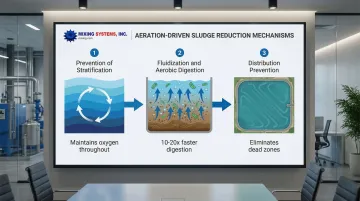
Aeration reduces sludge through three primary mechanisms: preventing stratification, fluidizing bottom sludge to enable aerobic digestion, and creating mixing patterns that prevent localized accumulation. Understanding these mechanisms is essential for selecting and sizing aeration systems.
Biological Activation and Aerobic Digestion
The fundamental advantage of aeration is biological: aerobic bacteria metabolize organic matter significantly faster than anaerobic bacteria. Facultative aerated lagoons exhibit BOD removal coefficients of 0.6-0.8 d⁻¹ at 20°C, compared to just 0.25-0.32 d⁻¹ in anaerobic zones—more than double the reaction rate.
This rate differential translates directly to sludge reduction. When aeration provides oxygen to the sludge layer, aerobic bacteria break down organic components at rates 10-20 times faster than anaerobic processes.
The aerobic advantage extends further: approximately 40% of volatile solids can be destroyed through endogenous respiration (self-digestion), where bacteria consume their own cellular mass once external food sources are depleted.
Case study data confirms these biological benefits. Buck Creek Lagoon demonstrated a 16% reduction in volatile solids within just 7 weeks of treatment optimization, with total sludge volume reduction of 170 m³ in the primary cell over one year.
Physical Fluidization and Sludge Distribution
While biological processes destroy organic matter, physical mixing prevents what remains from compacting. Certain aeration patterns create bottom currents that keep sludge in a fluidized state, preventing compaction and maintaining biological activity. This physical mechanism is particularly important for systems targeting complete sludge control rather than just oxygen delivery.
Fluidization requires sufficient mixing velocity—typically a minimum horizontal velocity of 0.3 m/sec (1 ft/sec)—to prevent settling and maintain contact between microorganisms and organic matter. Systems designed only for oxygen transfer often lack this mixing intensity, allowing sludge to compact in low-turbulence zones.
Prevention of Sludge Islands and Localized Buildup
Inadequate mixing leads to "dead zones" where sludge accumulates rapidly, particularly near inlets and along banks. Tracer studies have revealed that up to 28% of lagoon volume can become dead space in poorly mixed systems, with 26% of design volume filled with sludge.
Directional mixing patterns can excavate existing sludge islands by creating sustained bottom currents that redistribute accumulated solids. This capability varies dramatically by aeration technology—surface aerators provide localized vertical mixing with limited horizontal reach, while submerged systems can create sweeping horizontal patterns that address the entire lagoon floor.
Temperature and Seasonal Effects
Aeration prevents thermal stratification that would otherwise create anaerobic bottom conditions, particularly problematic in deeper lagoons. Without continuous mixing, lagoons stratify thermally during summer, with warm water floating above cold, dense bottom layers.
Seasonal turnover events occur in spring and fall when temperature changes cause the water column to invert, destabilizing the anaerobic sludge layer and resuspending solids. This releases odors and accumulated nutrients into the effluent, potentially causing permit violations. Continuous aeration eliminates this risk by maintaining uniform temperature throughout the water column.
Oxygen Transfer Efficiency and Sludge Management
High oxygen transfer efficiency alone does not guarantee good sludge management—the mixing pattern and energy distribution matter equally. A system with excellent Standard Oxygen Transfer Efficiency (SOTE) but poor mixing will meet DO requirements while still accumulating sludge in stagnant zones.
Types of Aeration Systems and Their Sludge Management Capabilities
Not all aeration systems are equally effective for sludge control. Selection should consider both oxygen delivery and mixing characteristics, as these determine whether the system will merely maintain DO or actively manage sludge accumulation.
Surface Aerators and Their Limitations
Floating surface aerators create vertical mixing patterns by churning water into the air, providing intense localized mixing but often lacking sufficient bottom mixing for sludge control.
Their mixing energy dissipates before reaching the bottom in deep water (typically >10-12 ft), allowing stratification and sludge buildup in areas beyond their immediate influence.
Surface aerators work best in shallow lagoons where their vertical mixing can reach the entire depth. They're also prone to icing in cold climates, which can lead to mechanical failure during winter months when treatment is already challenged by low temperatures.
Diffused Air Systems for Sludge Control
Diffused aeration systems pump air through submerged units, creating bubbles that rise through the water column. The bubble size determines both oxygen transfer efficiency and mixing characteristics.
Fine bubble systems produce small bubbles (<2mm) with high surface area, resulting in excellent oxygen transfer efficiency (4-7 lbs O₂/hp-hr). However, the gentle "fizzing" action creates less turbulence, which can fail to keep solids in suspension. Sludge may settle between diffusers, and the diffusers themselves are susceptible to fouling and clogging, requiring regular cleaning.
Coarse bubble systems produce large bubbles (>6mm) that rise rapidly, creating significant turbulence and vertical mixing superior for suspending sludge. While less efficient for oxygen transfer (1.6-3.3 lbs O₂/hp-hr), they excel at preventing sludge accumulation through aggressive mixing.
Jet Aeration Systems: Advanced Horizontal Mixing
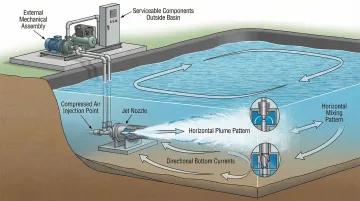
Where diffused systems rely on vertical bubble movement, submerged jet aeration technology takes a different approach. It combines high-velocity water jets with compressed air to create horizontal mixing patterns ideal for sludge fluidization. Unlike vertical mixing from surface aerators or bubble columns, jet systems produce directional bottom currents that sweep the entire lagoon floor.
The technology injects compressed air into a high-velocity water stream, creating intense shear forces that generate micro-bubbles (very fine diameter) with exceptional oxygen transfer characteristics.
The horizontal plume maintains the gas/liquid transfer interface longer than conventional diffused air systems, improving overall efficiency.
Mixing Systems, Inc. pioneered this approach with jet aerators designed for both performance and serviceability. Key advantages include:
- All mechanical assemblies placed outside the tank for easy service
- No in-basin moving parts to fail or require underwater maintenance
- Energy reductions of up to 40% compared to conventional methods
- Superior mixing for sludge control through directional currents
- Addresses both oxygen transfer and mixing requirements simultaneously
Hybrid and Staged Aeration Approaches
Facilities can combine different aeration methods or use intermittent aeration strategies to optimize both energy costs and sludge management. In one approach, fine bubble diffusers may provide baseline oxygen transfer while coarse bubble or jet systems operate periodically to prevent sludge accumulation.
A municipality in Danielsville, GA replaced inefficient surface aerators with fine bubble diffused systems, resolving low DO issues and improving sludge management by mixing and treating organic solids in place without increasing power costs. The upgrade demonstrated that technology selection must match both oxygen and mixing requirements.
Key Performance Parameters for Sludge Control
Aeration for sludge management requires specific design parameters beyond standard DO requirements. Understanding these parameters is essential for specifying systems that will actually control sludge rather than just maintain dissolved oxygen.
Mixing Power Density and Velocity Gradients
The relationship between power input per unit volume and ability to maintain solids in suspension or fluidized state is measurable and critical for design.
Recommended Mixing Power Densities:
| Treatment Objective | Power Density (Metric) | Power Density (Imperial) | Outcome |
|---|---|---|---|
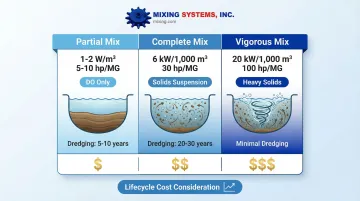
| Partial Mix (DO Only) | 1-2 W/m³ | 5-10 hp/MG | Oxygen transfer; solids settle |
| Complete Mix (Solids Suspension) | ~6 kW/1,000 m³ | ~30 hp/MG | Maintains solids in suspension |
| Vigorous Mix (Heavy Solids) | ~20 kW/1,000 m³ | ~100 hp/MG | Prevents all settling |
Most lagoons are designed as "Partial Mix" to save energy, accepting that sludge will accumulate and require periodic removal.
"Complete Mix" lagoons minimize sludge accumulation but have significantly higher operational energy costs—a tradeoff that must be evaluated based on lifecycle costs including dredging frequency.
Oxygen Transfer Rate and Standard Oxygen Transfer Efficiency
Standard Oxygen Transfer Efficiency (SOTE) measures how effectively an aeration system transfers oxygen from air into water under standard conditions (20°C, zero dissolved oxygen, clean water). Alpha factors (wastewater contaminants reduce transfer) and beta factors (salinity and temperature effects) lower field efficiency from these baseline values.
Typical SOTE ranges:
- Surface aerators: 1.0-1.2 kg O₂/kWh (low efficiency, high mixing)
- Fine bubble diffusers: 2.0-3.0 kg O₂/kWh (high efficiency, low mixing)
- Jet aerators: 1.5-2.5 kg O₂/kWh (balanced efficiency with superior mixing)
The highest SOTE doesn't necessarily deliver the best sludge management. Systems must balance oxygen transfer efficiency with mixing intensity to address both requirements simultaneously.
Aeration Pattern and Coverage Area
Different aeration technologies distribute energy throughout lagoon volumes in distinct patterns. Proper specification requires understanding coverage area, mixing zones, and dead spot elimination.
Verification methods include:
- Tracer studies: Dye tests reveal hydraulic short-circuiting and dead zones
- Sludge depth profiling: EPA recommends measurements at 12-24 points per cell using sludge judges or sonar profiling
- Velocity profiling: Confirms minimum horizontal velocity requirements (0.3 m/sec) for solids suspension
Factors Affecting Aeration Effectiveness and Common Misconceptions
Real-world performance depends on multiple factors beyond equipment specifications, and several persistent misconceptions lead to underperforming systems.
Factors That Influence Real-World Performance
Lagoon depth and geometry significantly affect aeration requirements. Deeper lagoons favor diffused aeration systems where longer bubble rise time increases oxygen transfer efficiency (SOTE increases approximately 6% per meter of depth).
Rectangular or irregular shapes create stagnant corners requiring careful aeration placement to ensure complete coverage.
Seasonal temperature variations dramatically impact biological activity. Aerobic bacteria thrive between 10-40°C with optimal range around 30-35°C.
In winter, biological activity slows significantly—while aeration prevents freezing and maintains some activity, sludge reduction rates will stall. Design calculations must account for these seasonal lulls.
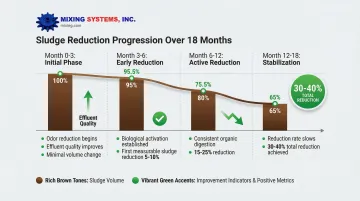
Existing sludge depth and age affect the timeline for achieving sludge reduction. Thick, compacted sludge layers require months to years for measurable reduction.
Operators should expect initial improvements in odor reduction and effluent quality, followed by gradual volumetric sludge reduction over 6-18 months depending on conditions.
Common Misconceptions About Aeration and Sludge
Meeting DO requirements automatically means adequate sludge management
Many systems meet dissolved oxygen targets but still accumulate excessive sludge because they lack the mixing power to fluidize bottom solids. DO compliance requires only 1-2 W/m³, while complete solids suspension requires 6-20 kW/1,000 m³—up to 10 times more energy.
Aeration can eliminate all sludge
Aeration reduces only the organic fraction—typically 49-80% of total sludge. Inorganic solids (sand, grit, silt) cannot be biologically degraded and will eventually require mechanical removal regardless of aeration quality.
All aeration technologies provide equivalent sludge control benefits
Technology selection dramatically affects outcomes. Fine bubble systems may meet oxygen requirements while allowing sludge accumulation between diffusers. Surface aerators create dead zones beyond their mixing radius. Jet systems provide directional mixing that addresses the entire lagoon floor.
Sludge reduction happens quickly
Realistic timeframes are 6-18 months for measurable reduction. Biological digestion is a gradual process—operators expecting immediate results will be disappointed. Patience and consistent monitoring are essential.
Conclusion
Aeration is not merely an oxygen delivery system but a critical sludge management tool when properly designed and operated.
The distinction between aeration for dissolved oxygen compliance and aeration for sludge control is fundamental. Systems sized only for DO requirements will inevitably accumulate sludge in poorly mixed zones, forcing costly dredging operations every 5-10 years.
Understanding the relationship between aeration technology, mixing patterns, and sludge behavior enables informed decisions that deliver measurable results:
- Extend lagoon life by decades
- Reduce maintenance costs by 50% or more
- Ensure long-term compliance with discharge permits
The key is recognizing that effective sludge management requires both adequate oxygen transfer AND sufficient mixing power to fluidize bottom solids, prevent stratification, and maintain biological activity throughout the sludge layer.
Frequently Asked Questions
How does aeration work in wastewater lagoons (activated sludge process)?
Aeration introduces oxygen to support aerobic bacteria that break down organic matter, while providing mixing to keep solids suspended. This dual function—oxygen delivery and mixing—drives both treatment efficiency and sludge management.
Should I aerate my wastewater lagoon?
Aeration improves treatment efficiency, reduces sludge by 30-60%, controls odors, and helps meet discharge requirements. Systems with high organic loading or strict effluent limits typically require aeration.
How do you remove sludge from a wastewater lagoon?
Sludge removal uses mechanical methods (dredging, vacuum trucks) or biological reduction through aeration. Proper aeration reduces organic sludge by 30-60% and extends cleanout intervals from 5-10 years to 20-30 years.
How often should a wastewater lagoon be cleaned of sludge?
Cleaning frequency depends on sludge accumulation rate, lagoon design, and regulatory requirements, typically ranging from 10-30 years for properly aerated systems versus 5-15 years for non-aerated systems. EPA recommends cleanout when sludge exceeds 25% of operating depth.
What's the difference between aeration for dissolved oxygen versus aeration for sludge control?
DO-focused aeration emphasizes oxygen transfer efficiency, while sludge control requires higher mixing power and flow patterns to suspend settled solids. Some systems meet DO requirements but lack adequate mixing for sludge management, leading to continued accumulation.