Introduction
Industrial facilities handling wastewater face mounting pressure to meet strict effluent standards while controlling operating costs. Aerobic wastewater treatment has become the solution of choice, with U.S. Publicly Owned Treatment Works (POTWs) alone processing over 34 billion gallons daily.
From chemical plants and pharmaceutical manufacturing to food processing facilities and municipal treatment plants, aerobic systems handle high-volume wastewater using oxygen-dependent bacteria to break down organic matter. This biological approach has become the preferred method for high-strength industrial wastewater requiring consistent effluent quality.
The shift is driven by regulatory requirements and operational efficiency. EPA secondary treatment standards mandate 30 mg/L BOD5 and TSS limits. Facilities need energy-efficient biological treatment capable of handling variable organic loads while maintaining compliance.
Key Takeaways
- Achieves 85-95% organic removal with oxygen-dependent bacteria breaking down wastewater contaminants
- Delivers BOD5 <30 mg/L and TSS <25 mg/L through aeration, clarification, and disinfection stages
- Outperforms conventional septic systems by 40-60% in treatment efficiency
- Serves municipal, chemical, pharmaceutical, food processing, and pulp & paper facilities
What Is an Aerobic Wastewater Treatment System?
An aerobic wastewater treatment system is a biological treatment process that uses oxygen and aerobic microorganisms to decompose organic matter in wastewater, converting pollutants into carbon dioxide, water, and biomass. Unlike passive anaerobic systems, aerobic treatment requires continuous power and active aeration.
Aerobic treatment was developed to achieve higher effluent quality than anaerobic systems can provide. It addresses the critical need for effective treatment of high-strength industrial wastewater—often containing 500 to 2,500+ mg/L BOD (biochemical oxygen demand)—and meeting stringent environmental discharge standards that conventional septic systems cannot achieve.
The technology delivers consistent secondary treatment performance, making it suitable for environmentally sensitive discharge locations and water reuse applications.
What Aerobic Treatment Is NOT
To avoid confusion, it's important to clarify what aerobic treatment is not:
- Simply adding air to a septic tank – Aerobic systems require engineered aeration equipment, process control, and specific retention times
- The same as activated sludge – Activated sludge is one type of aerobic system; others include fixed-film and hybrid designs
- Suitable for all scenarios – Aerobic treatment requires continuous power, regular maintenance, and proper operational oversight
Why Aerobic Treatment Remains the Industry Standard
Despite newer technologies, aerobic treatment offers the best balance of treatment effectiveness, operational reliability, and cost-effectiveness for medium-to-high strength wastewater. The activated sludge process alone treats 23 billion cubic meters annually in the U.S., representing 34% of total national flow.
Its proven performance across decades of industrial and municipal applications makes it the go-to solution for facilities requiring consistent compliance with discharge permits.
Main Types of Aerobic Systems
Aerobic systems differ in how they maintain bacterial populations:
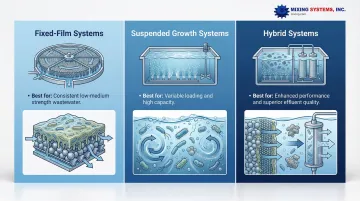
Fixed-film systems: Bacteria grow attached to stationary or moving media (plastic, ceramic, fabric). Examples include trickling filters, rotating biological contactors (RBCs), and moving bed biofilm reactors (MBBRs). Best suited for consistent low-to-medium strength wastewater.
Suspended growth systems: Bacteria float freely in aeration tanks as mixed liquor. The activated sludge process and its variations (conventional, extended aeration, aeration configurations) offer flexibility for variable loading and higher treatment capacity but require sophisticated process control.
Hybrid systems: Modern designs like Integrated Fixed-Film Activated Sludge (IFAS) combine both approaches, while membrane bioreactors (MBR) use ultrafiltration for superior effluent quality. Advanced jet aeration systems create multiple oxygen transfer zones through high-shear mixing, enhancing efficiency in deep tanks and high-strength industrial applications.
How Does Aerobic Wastewater Treatment Work?
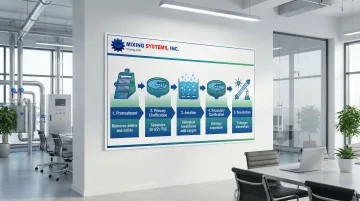
Aerobic wastewater treatment operates through a carefully sequenced series of stages, each designed to progressively remove contaminants and produce high-quality effluent suitable for discharge or reuse.
Pretreatment and Solids Removal
Raw wastewater begins its treatment journey through screening and grit removal. This eliminates large debris, plastics, rags, sand, and other materials that could damage equipment.
Wastewater then flows into a primary clarifier where gravity causes separation. Heavier suspended solids sink to form primary sludge while oils and grease float to the surface for skimming. Primary clarification typically removes 50-65% of TSS and 20-35% of BOD5 before biological treatment.
Why this stage is critical:
- Reduces organic load on the aeration system by 25-40%
- Prevents equipment clogging from large solids
- Improves overall treatment efficiency and reduces energy consumption
- Removes settleable solids with 90-95% efficiency
Design parameters:
- Detention time: 1.5 to 3.0 hours
- Surface overflow rate: 800-1,200 gal/d•ft² at average flow
- Weir loading: Up to 20,000-30,000 gal/ft•d depending on plant size
Operators must balance detention time carefully. Too short reduces settling efficiency, while too long can cause septic conditions.
Systems must also handle flow variations without washing settled solids back into the treatment stream.
Aeration - The Core Biological Process
In the aeration chamber, compressed air or mechanical aerators introduce oxygen into wastewater. This creates an oxygen-rich environment where aerobic bacteria rapidly multiply and consume dissolved organic matter, converting it into carbon dioxide, water, and new bacterial cells (biomass).
Billions of aerobic microorganisms form suspended flocs (clumps) that move through the mixed liquor, continuously absorbing and digesting organic pollutants.
The process requires dissolved oxygen levels of 2-3 mg/L for organic removal and typically 4-8 hours of detention time depending on wastewater strength.
Aeration methods and their applications:
Fine bubble diffused aeration: Creates very small bubbles with high surface area, maximizing oxygen transfer. Commonly used in municipal plants with consistent loading.
High-density fine bubble aeration: Provides superior oxygen transfer efficiency, ideal for high-efficiency retrofits and energy optimization.
Coarse bubble aeration: Produces larger bubbles with vigorous mixing action. Well-suited for applications requiring solids suspension and tank mixing.
Mechanical surface aeration: Uses rotating impellers to splash water into the air. Often found in lagoons, oxidation ditches, and smaller package plants.
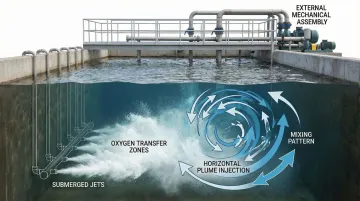
Jet aeration systems: Combines high-velocity liquid jets with compressed air to create intense mixing and micro-bubbles. Particularly effective in deep tanks and for high-strength industrial wastewater.
Aeration typically consumes 55% of a facility's total energy, making oxygen transfer efficiency the most critical performance variable. Modern fine-bubble systems maximize oxygen dissolution per unit of energy, with factors including bubble size (smaller = more surface area), contact time (longer = better transfer), and mixing intensity affecting overall performance and operating costs.
Jet aeration systems offer particular advantages in deep tank applications, where submerged jets create multiple oxygen transfer zones and maintain thorough mixing without in-basin moving parts.
Process control requirements:
Operators must continuously monitor several parameters:
- Dissolved oxygen levels (2-3 mg/L minimum)
- Mixed liquor suspended solids (MLSS typically 2,000-4,000 mg/L)
- Food-to-microorganism ratio (F/M ratio 0.2-0.5 for conventional systems)
- Sludge age and waste rates
Secondary Clarification
After aeration, the mixed liquor flows to a secondary clarifier where calm conditions allow bacterial flocs (activated sludge) to settle by gravity, separating treated water from biomass. This stage is critical for maintaining treatment quality and preventing solids from escaping in the final effluent.
A portion of settled sludge—called return activated sludge (RAS)—is pumped back to the aeration tank to maintain bacterial population. Meanwhile, excess sludge (waste activated sludge or WAS) is removed to prevent biomass accumulation and maintain system balance.
Performance indicators:
- Clear supernatant with less than 30 mg/L suspended solids
- Sludge Volume Index (SVI) target of 125 mL/g (upper control limit 150 mL/g)
- Stable sludge blanket without rise toward the weir
Poor settling is the most common cause of effluent quality violations in aerobic systems. Filamentous bulking—caused by overgrowth of filamentous bacteria like Sphaerotilus natans—prevents proper floc compaction.
Contributing factors include:
- Low dissolved oxygen levels
- Low F/M ratios
- Nutrient deficiencies
- Temperature fluctuations
Disinfection and Final Treatment
Once clarified, the effluent undergoes disinfection to eliminate pathogenic bacteria, viruses, and other disease-causing microorganisms. Typical permit limits require fecal coliform levels below 200 CFU/100 mL (30-day geometric mean) or total coliform below 1,000 CFU/100 mL.
Common disinfection methods:
Chlorination: Using sodium hypochlorite, calcium hypochlorite, or chlorine gas with 15-30 minute contact time. Effective but requires dechlorination for sensitive receiving waters to prevent aquatic toxicity.
UV disinfection: Exposing wastewater to UV-C light at 254 nm wavelength. Doses of approximately 25 mJ/cm² achieve fecal coliform targets for secondary effluent, while reuse applications require higher doses (>80 mJ/cm²). UV effectiveness decreases if TSS exceeds 30 mg/L.
Ozone treatment: Powerful oxidant with no residual concerns, but higher capital and operating costs.
Disinfection requirements vary based on receiving water use—stricter for recreational waters or drinking water sources—and reuse applications, with the highest standards required for irrigation of food crops.
Output and Effluent Quality
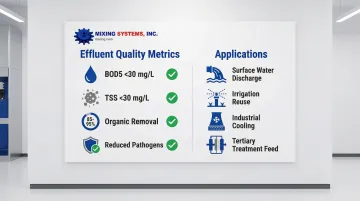
Aerobic treatment ultimately produces high-quality secondary effluent typically containing:
- Less than 30 mg/L BOD5
- Less than 30 mg/L TSS
- 85-95% removal of organic matter
- Significantly reduced pathogen levels compared to raw wastewater
This output quality enables multiple downstream applications:
- Direct discharge to surface waters under NPDES permits
- Non-potable reuse (irrigation, industrial cooling, toilet flushing)
- Tertiary treatment feed for further polishing
- Subsurface absorption field discharge in some cases
Consistent effluent quality prevents regulatory violations, which can cost $10,000-$50,000 per day in fines under the Clean Water Act.
It also protects receiving water ecosystems from oxygen depletion and eutrophication, while enabling water reuse that can offset 30-50% of facility water costs in water-scarce regions.
Types of Aerobic Treatment Systems
Fixed-Film Systems
Fixed-film systems use stationary or moving media that provides surface area for biofilm growth. Bacteria attach and form colonies that treat wastewater as it flows past, eliminating the need for sludge return systems.
Common fixed-film configurations:
- Trickling filters — wastewater distributed over rock or plastic media with gravity flow
- Rotating biological contactors (RBCs) — rotating disks partially submerged in wastewater
- Moving bed biofilm reactors (MBBRs) — plastic carriers move freely in aeration tanks, combining biofilm and suspended growth advantages
Fixed-film systems work well with consistent low-to-medium strength wastewater and are approximately 20% lower in capital cost than some suspended growth alternatives, though operating costs can be higher.
Suspended Growth Systems
The activated sludge process keeps bacteria suspended in mixed liquor through continuous aeration and mixing. This approach offers flexibility for variable loading and higher treatment capacity.
However, it requires more sophisticated process control than fixed-film systems.
Activated sludge variations:
- Conventional — MLSS of 2,000-3,000 mg/L, F/M ratio 0.2-0.5
- Extended aeration — lower F/M ratios (0.03-0.10), longer detention times, more stable operation
- aeration configurations — batch process performing aeration and settling in the same tank, excellent for fluctuating flows
Suspended growth systems are the most widely used biological treatment method globally, treating 34% of U.S. wastewater flow through basic activated sludge processes alone.
Hybrid and Advanced Systems
Building on these foundational approaches, modern designs combine technologies for enhanced performance:
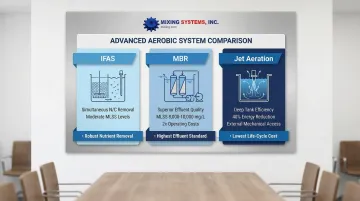
IFAS (Integrated Fixed-Film Activated Sludge): Combines suspended growth with fixed media in the same tank, effective for simultaneous nitrogen and carbon removal
Membrane Bioreactors (MBR): Replace secondary clarifiers with ultrafiltration membranes, producing superior effluent quality (low turbidity/bacteria) with MLSS of 8,000-10,000 mg/L. Operating costs are approximately double that of fixed-bed systems due to membrane maintenance.
Jet aeration systems: Create multiple oxygen transfer zones through high-shear mixing and horizontal plume injection. These systems maintain gas/liquid transfer interfaces longer than conventional diffused air, offering enhanced efficiency in deep tanks and high-strength industrial wastewater applications. Mixing Systems, Inc. designs jet aerators with all mechanical assemblies placed outside tanks for easy service access, achieving energy reductions of up to 40% over conventional aeration methods.
Where Aerobic Treatment Systems Are Used
Operational Integration
Aerobic systems serve as the primary biological treatment stage after pretreatment/screening and before final clarification and disinfection in municipal plants.
They also function as the main treatment component in package plants for industrial facilities, commercial developments, and institutions (schools, hospitals, military bases) lacking access to municipal sewers.
Best Operating Conditions
Aerobic treatment performs best under these conditions:
- Temperature: 20-35°C (68-95°F) where bacterial activity is optimal
- Flow consistency: Relatively consistent flow and loading, or with equalization
- Space constraints: More compact than lagoons or wetlands (important for land-limited sites)
- Effluent requirements: Where high quality is non-negotiable due to sensitive receiving waters or reuse standards
Key Industries and Applications
These systems meet diverse treatment needs across multiple sectors:
- Municipal wastewater treatment plants: Serving populations from 500 to 5 million+, handling domestic sewage and some industrial contributions
- Food and beverage processing: Dairies, breweries, meat processing with high BOD wastewater (500-2,500+ mg/L). [MBBR and aeration configurations systems handle shock loads effectively](https://www.nihaowater.com/news/mbbr-vs-mbr-vs-aeration configuration-vs-sbbr-vs-asp-a-comprehensive-guide-to-wastewater-treatment-technologies.html)
- Pharmaceutical and chemical manufacturing: Requiring treatment of complex organic compounds with high COD/BOD, with MBR systems preferred for superior effluent quality
- Pulp and paper mills: Handling high-volume, high-strength process water with complex organics and phenols using extended aeration activated sludge
- Commercial facilities: Office parks, shopping centers, and resorts in areas without centralized sewer infrastructure
Mixing Systems, Inc. has supplied jet aeration and mixing equipment to hundreds of installations across these sectors. Major clients include Dow Chemical, BASF, Pfizer, Cargill, and Anheuser Busch.
Conclusion
Aerobic wastewater treatment harnesses the natural metabolic processes of oxygen-dependent bacteria to efficiently break down organic pollutants, transforming contaminated water into clean effluent through controlled biological digestion.
The technology's dominance—treating over 34 billion gallons daily in the U.S. alone—reflects its proven effectiveness in meeting stringent discharge standards while offering operational reliability across diverse applications.
Understanding how aerobic systems work enables better operational decisions. Key knowledge areas include:
- Oxygen transfer efficiency: Critical for system performance—advanced aeration technologies like jet aeration systems can reduce energy consumption by up to 40% compared to conventional methods
- Bacterial population control: Maintaining proper MLSS and F/M ratios ensures consistent treatment performance
- Performance optimization: Since aeration accounts for 55% of operating costs, selecting efficient equipment directly impacts profitability
- Operational troubleshooting: Identifying and resolving issues like filamentous bulking prevents discharge violations
This knowledge minimizes operating costs, avoids regulatory penalties, and delivers reliable treatment performance that protects water resources and enables beneficial reuse.
Frequently Asked Questions
What is the aerobic system in wastewater treatment?
An aerobic system uses oxygen and aerobic bacteria to biologically decompose organic matter in wastewater, producing cleaner effluent than anaerobic methods. Common types include activated sludge, trickling filters, rotating biological contactors, and jet aeration systems.
How much does an aerobic wastewater treatment system cost?
Costs vary widely: residential systems range from $10,000-$25,000, small commercial systems $50,000-$200,000, and municipal plants $500,000 to millions depending on capacity. Annual operating costs typically run 10-15% of capital costs, with energy representing approximately 55% of OPEX.
What equipment is needed for mechanical aeration?
Core components include air blowers or compressors, air distribution piping, diffusers or aerators (such as fine bubble, coarse bubble, jet aerators, or mechanical surface units), and process controls to regulate oxygen levels and maintain optimal treatment.
What is the difference between aerobic and anaerobic wastewater treatment?
Aerobic treatment uses oxygen to produce cleaner effluent (BOD <30 mg/L) but requires aeration energy. Anaerobic treatment operates without oxygen, produces lower quality effluent but generates methane and uses no aeration energy. Facilities prefer aerobic systems when discharge or reuse standards demand high effluent quality.
How do you maintain an aerobic wastewater treatment system?
Key tasks include daily DO monitoring, monthly diffuser/aerator inspection and cleaning, weekly effluent testing for BOD/TSS/pH, sludge removal to maintain MLSS levels, and scheduled blower/pump servicing per manufacturer guidelines.
What industries benefit most from aerobic treatment systems?
Food and beverage processing, pharmaceutical and chemical manufacturing, pulp and paper mills, and any facility needing secondary treatment standards (85% BOD/TSS removal, <30 mg/L effluent) or better benefit most from aerobic systems.