Introduction
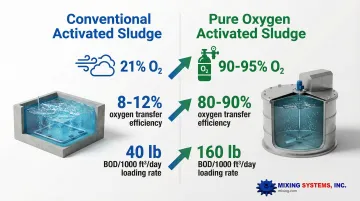
Conventional wastewater treatment plants rely on atmospheric air containing just 21% oxygen. Pure oxygen activated sludge (POAS) systems deliver high-purity oxygen gas at 90%+ concentration, creating a 4-5x increase in oxygen driving force that enables treatment capacities impossible with standard aeration.
Understanding POAS is increasingly critical for plant operators, municipal decision-makers, and consulting engineers. As infrastructure reaches capacity limits and discharge regulations tighten, facilities face costly expansions requiring additional land—or intensifying treatment within existing footprints.
POAS technology addresses space constraints, handles high organic loads from industrial discharges, and enables aging facilities to double or triple capacity without building new tanks. This makes it a strategic solution when land costs are prohibitive or expansion permits are difficult to obtain.
This article explains what pure oxygen activated sludge is, walks through the process step-by-step from oxygen generation to final clarification, identifies the critical factors that determine system performance, and clarifies when POAS represents the right investment versus conventional activated sludge systems.
Key Takeaways
- POAS achieves 80-90% oxygen transfer efficiency using 90-95% pure oxygen versus 8-12% for conventional diffused air systems
- Enables 2-4x higher volumetric loading rates (160 vs 40 lb BOD/1000 ft³/day) while cutting energy consumption up to 40%
- Higher biomass concentrations (3000-5000 mg/L MLSS) and shorter retention times (1.5-4 hours) reduce required tank volume
- Ideal for high-strength industrial wastewater, space-constrained retrofits, and capacity expansions without major construction
- Capital investment runs 20-40% higher than conventional systems with added complexity for pH control, CO2 venting, and oxygen safety
What Is Pure Oxygen Activated Sludge?
Pure oxygen activated sludge (POAS) is a biological wastewater treatment process that uses high-purity oxygen gas—typically 90-95% oxygen concentration—instead of atmospheric air to support microbial decomposition of organic matter in covered reactor tanks.
The process removes biochemical oxygen demand (BOD), chemical oxygen demand (COD), and suspended solids from wastewater while maintaining significantly higher treatment capacity within a smaller physical footprint compared to conventional activated sludge systems.
The fundamental difference lies in oxygen delivery and reactor design:
- Conventional systems: Blow atmospheric air (21% oxygen) into open basins where only 8-12% dissolves into wastewater
- POAS systems: Introduce pure oxygen into covered, gas-tight tanks where 80-90% transfers into solution, creating dramatically more efficient mass transfer
Oxygen Generation Methods
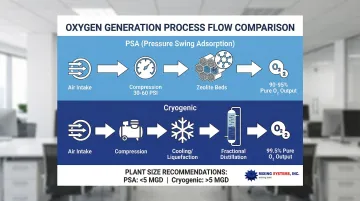
POAS facilities generate pure oxygen through two primary methods:
Pressure Swing Adsorption (PSA): Compressed atmospheric air at 30-60 PSI passes through molecular sieve beds containing zeolite material that selectively adsorbs nitrogen and other gases while allowing oxygen to pass through. Multiple beds cycle between adsorption and regeneration modes to provide continuous oxygen supply.
PSA systems produce 90-95% pure oxygen and are economical for smaller plants (under 5 MGD), offering flexible turndown capability to match variable oxygen demand.
Cryogenic Air Separation: Atmospheric air is compressed, cooled, filtered, and chilled to cryogenic temperatures where it liquefies. Fractional distillation separates liquid nitrogen from liquid oxygen based on their different boiling points. The oxygen is then warmed and delivered to reactors as gas or stored as liquid for backup supply.
This method produces oxygen purities exceeding 99.5% and becomes cost-effective for larger facilities (over 5 MGD) due to economies of scale, despite higher complexity and energy requirements.
POAS is also known as the UNOX process (a proprietary name from the technology's early development) or High Purity Oxygen Activated Sludge (HPOAS).
Approximately 110 municipal POAS systems currently operate in North America, treating flows ranging from small package plants under 1 MGD to major facilities processing over 100 MGD, such as the 63 MGD plant near Stanford, California.
Why Pure Oxygen Activated Sludge Is Used in Wastewater Treatment
Facilities adopt POAS to overcome fundamental limitations of conventional aeration systems. The technology achieves volumetric loading rates of 160 lb BOD/1000 ft³/day—four times the 40 lb BOD/1000 ft³/day typical of conventional systems.
This capacity increase allows plants to upgrade existing facilities without major expansion, handle high-strength industrial wastewater that would overwhelm conventional systems, and reduce energy consumption by up to 40% through superior oxygen transfer efficiency.
Treatment Challenges POAS Addresses
POAS solves specific operational problems that conventional systems struggle with:
- Space limitations: Existing plants at capacity with no room for additional aeration basins can increase treatment capacity 2-4x within existing tankage
- High organic loading: Industrial discharges from petrochemical, pharmaceutical, and food processing facilities with BOD concentrations exceeding 500 mg/L require excessive aeration basin volumes with conventional treatment
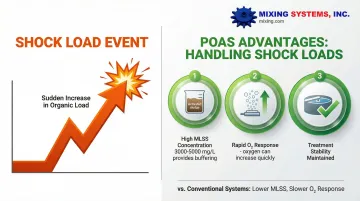
- Variable or shock loading: Sudden increases in organic load from industrial discharges can overwhelm conventional systems' oxygen transfer capacity
- Cold weather operation: Low temperatures reduce oxygen solubility and biological activity; POAS maintains higher dissolved oxygen levels to compensate
- Energy costs: Conventional diffused air systems waste 88-92% of the oxygen they generate through inefficient mass transfer
Consequences of Inadequate Oxygen Transfer
Operating with conventional aeration under these conditions creates multiple problems:
- Dissolved oxygen drops below 2 mg/L during peak loads, creating incomplete BOD removal and potential permit violations
- Filamentous bacteria proliferate under low-DO conditions, causing bulking sludge that settles poorly and washes out with effluent
- Large footprint requirements make expansion prohibitively expensive in urban areas where land costs $500,000+ per acre
- High energy costs result from running blowers at maximum capacity to achieve marginal oxygen transfer improvements
- Inability to meet discharge limits during high-load periods requires expensive equalization storage or load shedding arrangements with industrial dischargers
Industry Adoption and Performance
These operational challenges drive POAS adoption in applications where its advantages justify 20-40% higher capital costs. The technology is particularly common in petrochemical refineries, pharmaceutical manufacturing, food processing (breweries, bottlers, meat packing), and pulp/paper mills that generate high-strength wastewater.
Municipal plants increasingly adopt POAS when facing capacity constraints that would otherwise require costly expansions.
Research from the EPA documents that POAS systems consistently achieve 95%+ BOD removal rates while reducing energy consumption by approximately 40% compared to conventional aeration.
The Westgate Treatment Plant in Fairfax County, Virginia, upgraded from an 8 MGD primary facility to a 14 MGD secondary treatment system using POAS in existing tanks, achieving 92% BOD removal—demonstrating the technology's capacity expansion potential without new construction.
How the Pure Oxygen Activated Sludge Process Works
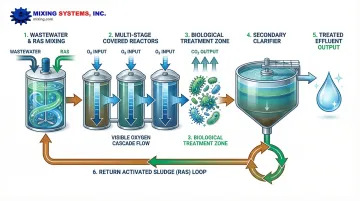
The POAS treatment flow begins after preliminary screening and grit removal. Wastewater enters a series of covered reactor tanks where it mixes with return activated sludge (RAS) containing concentrated microorganisms at 8,000-12,000 mg/L. Pure oxygen gas is introduced into the first reactor stage and cascades through 3-5 sequential stages, with each stage separated by baffles but hydraulically connected.
Microorganisms consume dissolved organic matter using the abundant oxygen, converting BOD to carbon dioxide, water, and new cell mass. Mixed liquor flows from the final reactor stage to a conventional secondary clarifier where treated water separates from biomass. Clarified effluent discharges while concentrated sludge returns to the first reactor to maintain the active microbial population.
Process Inputs
Four primary inputs drive the POAS process:
- Wastewater: Primary or screened effluent containing BOD/COD and suspended solids
- Pure oxygen gas: Generated on-site via PSA or cryogenic separation, or delivered as liquid oxygen
- Return activated sludge: Concentrated biomass from the clarifier containing 8,000-12,000 mg/L MLSS
- Nutrients: Nitrogen and phosphorus supplementation when treating industrial wastewater (target BOD:N:P ratio of 100:5:1)
Core Biological Transformation
Inside the covered reactors, aerobic bacteria and other microorganisms form floc particles and consume dissolved organic matter. The covered tanks maintain dissolved oxygen concentrations of 4-10 mg/L in the mixed liquor—significantly higher than the 2-4 mg/L typical in conventional systems.
This elevated DO level drives faster biological oxidation rates and supports higher biomass concentrations.
Carbon dioxide produced by microbial respiration accumulates in the tank headspace. Without proper venting, CO2 dissolves to form carbonic acid, potentially dropping pH below 6.5 and inhibiting biological activity. Operators must balance oxygen retention (to maximize utilization) against CO2 removal (to maintain neutral pH).
Process Control and Operational Parameters
POAS systems employ automated control strategies:
- Oxygen feed rate: Adjusts based on reactor headspace pressure (typically maintained at 2-4 inches water column) and dissolved oxygen measurements
- Hydraulic retention time: Controlled at 1.5-4 hours (versus 6+ hours for conventional systems) through flow pacing
- MLSS concentration: Maintained at 3000-5000 mg/L through waste activated sludge removal
- Mixing equipment: Mechanical surface aerators or jet aerators ensure uniform conditions and oxygen dissolution throughout each reactor stage
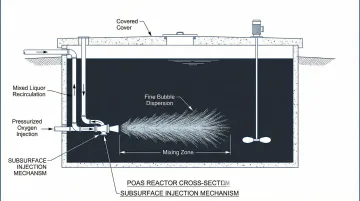
Jet aeration systems offer distinct advantages in POAS applications. These systems combine pressurized oxygen with recirculated mixed liquor for subsurface injection, creating multiple oxygen transfer zones within each reactor stage. With no in-basin moving parts, jet aerators reduce maintenance requirements while achieving superior oxygen transfer efficiency.
Mixing Systems, Inc. specializes in jet aeration technology designed for high-purity oxygen applications. The company's systems deliver proven mass transfer performance in hundreds of industrial installations worldwide.
Process Outcomes
The biological treatment produces measurable changes in water quality:
- BOD reduced by 85-98%
- Suspended solids reduced by 85-95%
- Dissolved oxygen in effluent typically 1-3 mg/L
- Waste activated sludge produced at 0.4-0.6 lb/lb BOD removed (similar to conventional systems)
- Treated effluent meets secondary treatment standards (typically <30 mg/L BOD and <30 mg/L TSS)
Oxygen Generation and Supply
The reliability of oxygen supply determines overall system performance. Facilities choose between two generation technologies based on scale and operational requirements.
Pressure Swing Adsorption (PSA) systems compress atmospheric air to 30-60 PSI and pass it through molecular sieve beds. The zeolite material adsorbs nitrogen, argon, and other gases while allowing oxygen to pass through. Multiple beds cycle between adsorption (producing oxygen) and regeneration (purging adsorbed gases) to provide continuous supply.
PSA produces 90-95% pure oxygen and is economical for plants under 5 MGD. The technology offers wide operating range to match variable oxygen demand—critical for facilities with fluctuating industrial loads.
Cryogenic Air Separation compresses, cools, and liquefies atmospheric air, then uses fractional distillation to separate oxygen (boiling point -297°F) from nitrogen (boiling point -320°F). The oxygen is warmed to ambient temperature and delivered to reactors as gas, or stored as liquid for backup supply during equipment maintenance or peak demand periods. Cryogenic systems produce oxygen purities exceeding 99.5% and become cost-effective for facilities over 5 MGD due to economies of scale, despite higher complexity and energy intensity (0.35-0.45 kWh/Nm³ O2 at large scale).
Reactor Operation and Mixing
POAS reactors employ a multi-stage covered configuration.
Three to five reactor stages arranged in series provide plug-flow characteristics while maintaining complete mixing within each stage. Baffles separate stages hydraulically while allowing mixed liquor to flow forward and oxygen-rich gas to cascade backward or forward depending on design.
Oxygen concentration in the headspace decreases progressively from stage 1 (90%+ oxygen) through the final stage (50-60% oxygen when vented). Covers maintain slight positive pressure (2-4 inches water column) to force oxygen into solution and prevent air infiltration that would dilute the oxygen and reduce efficiency.
Mixing and oxygen dissolution equipment options include:
- Mechanical surface aerators: Create turbulence at the liquid surface to entrain and dissolve oxygen
- Jet aerators: Combine pressurized oxygen with recirculated mixed liquor for subsurface injection, creating fine bubbles and intense mixing zones
- Sparged turbines: Use submerged impellers with oxygen diffusers to create high shear mixing
Proprietary jet aeration systems achieve 80-90% oxygen dissolution efficiency—ten times the 8-12% typical of conventional diffused air systems. The horizontal plume injection pattern maintains the gas-liquid interface longer than vertical bubble rise, maximizing contact time and mass transfer.
Clarification and Sludge Management
Mixed liquor from the final reactor stage flows to a conventional secondary clarifier. The high MLSS concentration (3000-5000 mg/L) settles readily when biological conditions are properly maintained, producing dense floc with good settling characteristics. Clarified effluent overflows the weirs while thickened sludge (typically 8,000-12,000 mg/L) collects at the clarifier bottom.
Return activated sludge pumps send concentrated biomass back to the first reactor stage at 50-150% of influent flow rate, maintaining the target MLSS concentration.
Waste activated sludge is removed periodically to control sludge age, typically maintained at 2-5 days for POAS versus 5-15 days for conventional systems. The shorter sludge age reflects the higher metabolic rates achieved under elevated dissolved oxygen conditions.
Key Factors That Affect the Pure Oxygen Activated Sludge Process
Several critical operating parameters determine POAS performance and require continuous monitoring and adjustment.
Primary Operating Parameters
- Dissolved oxygen concentration: Maintain 4-10 mg/L throughout the reactor train; levels below 4 mg/L reduce treatment efficiency while levels above 10 mg/L waste oxygen
- Mixed liquor pH: Keep above 6.5 to prevent inhibition of biological activity; CO2 accumulation in covered tanks can depress pH, requiring monitoring and possible caustic addition
- MLSS concentration: Target range of 3000-5000 mg/L; too low reduces treatment capacity, too high causes settling problems
- F/M ratio: Food-to-microorganism ratio maintained at 0.3-1.0 lb BOD/lb MLVSS/day to balance treatment rate against sludge production
- Reactor gas space pressure: Hold at 2-4 inches water column to optimize oxygen dissolution without excessive structural requirements
- Oxygen purity in vent gas: Typically vented when O2 drops below 50% to prevent excessive CO2 accumulation
Equipment and System Dependencies
Maintaining optimal parameters requires reliable equipment operation. Key system dependencies include:
- Oxygen generation system: PSA or cryogenic units must operate continuously; backup liquid oxygen storage prevents treatment upsets during equipment failures. Without backup, PSA compressor failure can disrupt treatment within hours as dissolved oxygen depletes
- Mixing equipment: Uniform reactor conditions prevent dead zones where solids settle and biological activity declines. Jet aerators provide advantages with no in-basin moving parts that could fail and require tank dewatering for repair
- CO2 venting control: Automatic vent valves strip CO2 while retaining oxygen. Vent valve failure can cause rapid pH depression and biological inhibition
- Automated control systems: PLCs adjust oxygen feed rates based on pressure and DO setpoints, maintaining optimal conditions despite flow and load variations
- Clarifier performance: High-quality activated sludge return is essential; poor settling due to bulking or pin floc reduces RAS concentration and disrupts reactor MLSS
Wastewater Characteristics and Loading Considerations
The characteristics of incoming wastewater significantly affect POAS performance:
Organic strength: High-strength industrial wastewater (>500 mg/L BOD) benefits most from POAS, as the technology's capacity for rapid oxygen transfer matches the high oxygen demand.
Low-strength municipal wastewater (<200 mg/L BOD) may not justify the added complexity and cost.
Temperature effects: Cold weather reduces biological reaction rates, but POAS maintains better performance than conventional systems due to higher dissolved oxygen levels that partially compensate for slower kinetics.
Toxic or inhibitory compounds: Heavy metals, solvents, or other industrial chemicals require careful monitoring. POAS systems tolerate shock loads better than conventional systems due to higher biomass concentration and oxygen availability, but sustained toxin exposure will inhibit treatment.
Nutrient balance: Biological treatment requires a BOD:N:P ratio of approximately 100:5:1. Industrial wastewater often lacks sufficient nutrients, requiring supplementation with ammonia and phosphoric acid.
Shock loads: POAS handles sudden organic load increases better than conventional systems because the high MLSS concentration provides buffering capacity and oxygen can be rapidly increased to meet demand.
Where Pure Oxygen Activated Sludge Is Applied
POAS technology finds application in specific facility types and industries where its advantages justify the higher capital investment.
Common Industries and Facility Types
- Petrochemical refineries and chemical plants treat high-strength wastewater with BOD concentrations reaching 500-2000 mg/L
- Pharmaceutical manufacturers handle variable, high-strength waste streams requiring flexible capacity
- Food and beverage processors (breweries, bottlers, meat processing) face high organic loads in limited space
- Pulp and paper mills process effluents containing elevated BOD and suspended solids
- Municipal wastewater plants upgrade capacity without expanding footprint or meet stringent discharge limits
- Industrial parks operate centralized systems serving multiple tenants with variable discharge patterns
Selection Triggers and Conditions
Facilities typically choose POAS over conventional activated sludge when facing these conditions:
Capacity constraints: Existing conventional plant at maximum capacity with no available land for expansion tanks. POAS can often double capacity within existing tankage.
High organic loading: When influent BOD exceeds 40 lb/1000 ft³/day on existing basin volume, conventional aeration cannot maintain adequate dissolved oxygen. POAS handles 160 lb/1000 ft³/day in the same volume.
Land costs: Urban facilities where land costs exceed $500,000 per acre make horizontal expansion prohibitively expensive. POAS concentrates treatment capacity vertically.
Variable industrial discharge: Facilities receiving batch discharges from industrial users need system flexibility to handle 2-3x average load during peak periods.
Cold climate operation: Northern facilities where winter temperatures drop below 50°F struggle to maintain dissolved oxygen with conventional aeration. POAS maintains 4-10 mg/L DO regardless of temperature.
Permit requirements: Stringent discharge limits (<10 mg/L BOD) or future requirements for nutrient removal drive selection of advanced treatment technologies.
New Construction vs. Retrofits
The selection criteria above apply to both new facilities and existing plant upgrades, though each context offers distinct advantages.
Retrofit applications often provide the strongest economic justification. Converting existing overloaded conventional tanks to POAS can double or triple capacity for 20-40% additional capital investment—far less than building new tanks.
New construction projects typically involve space-limited sites where minimizing footprint is critical due to land costs or site constraints. Industrial facilities with known high-strength wastewater characteristics often specify POAS from initial design.
Approximately 1 in 6 of the 110 operating municipal POAS systems in North America includes biological nutrient removal (BNR) capability. Modified reactor configurations incorporating anoxic zones before the aerobic POAS stages enable nitrogen removal.
This configuration adds complexity and reduces the organic loading advantage, but meets increasingly stringent nutrient discharge limits.
Common Challenges and Misconceptions
Operating Cost Misconceptions
Many assume POAS is always more expensive to operate due to oxygen generation costs. While capital costs run 20-40% higher than conventional systems, operating costs may actually be lower.
The significant energy savings from superior oxygen transfer efficiency (80-90% vs 8-12%) often outweighs oxygen generation costs. Smaller footprint reduces construction costs, and the ability to handle higher loads defers or eliminates expansion expenses.
Total cost of ownership depends on site-specific factors. Facilities with high electricity rates and low land costs may favor conventional systems. Urban facilities with expensive land, moderate electricity rates, and high-strength wastewater typically see favorable POAS economics. A proper evaluation requires lifecycle cost analysis including capital, energy, maintenance, and avoided expansion costs.
pH Control and CO2 Management
A common misconception is that covered tanks create insurmountable pH problems. Reality tells a different story.
Proper system design includes adequate venting of CO2-rich gas from the headspace. Modern POAS systems successfully maintain pH above 6.5 through automated monitoring and control.
pH control follows a straightforward sequence:
- Vent valves on the final reactor stage provide primary control
- When pH drops below setpoint (typically 6.7-6.8), valves open wider to strip CO2
- System vents gas even at 60%+ oxygen content if needed to maintain pH
- Caustic addition provides supplemental control if venting alone is insufficient
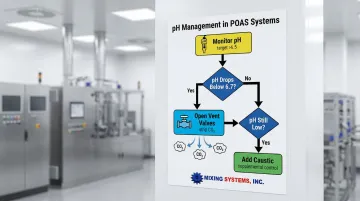
The key insight? pH management is a normal operational parameter, not an insurmountable barrier.
"More Oxygen Always Means Better Treatment"
While POAS provides superior oxygen transfer, successful treatment still depends on fundamental biological principles:
- Proper food-to-microorganism ratio
- Adequate mixing throughout the reactor
- Appropriate sludge age for target organisms
- Nutrient balance (nitrogen, phosphorus)
- Absence of toxic compounds
Simply adding more oxygen won't fix a poorly operated system. Inadequate mixing, excessive F/M ratio, or toxic shock loads require proper process control, not just higher dissolved oxygen.
Operators must understand that POAS requires the same attention to biological fundamentals as conventional activated sludge. The high oxygen transfer capacity provides operational flexibility and handles higher loads, but it doesn't eliminate the need for proper process control and monitoring.
When Pure Oxygen Activated Sludge May Not Be Appropriate
POAS isn't right for every situation. Several scenarios favor conventional or alternative treatment technologies.
Situations Where POAS Is Unnecessary
Small facilities (<0.5 MGD): Capital costs for oxygen generation equipment cannot be justified when conventional extended aeration works adequately at lower cost.
Ample land with low organic loading: Plants with available land and influent BOD below 200 mg/L can use conventional activated sludge at lower capital cost.
Highly variable flow: Facilities with 5:1 or greater peak-to-average flow ratios would require oversized oxygen generation equipment operating inefficiently most of the time. Flexible aeration configurations may handle variability better.
Long sludge age requirements: Applications requiring sludge ages exceeding 15 days—such as cold-climate nitrification—are difficult to achieve in POAS due to the high organic loading rates that drive shorter sludge ages.
Operational Constraints
Several constraints reduce POAS effectiveness or create operational risks:
- Lack of skilled operators: POAS requires operators trained in oxygen generation equipment, gas-tight reactor operation, and pH control strategies
- Inadequate maintenance capabilities: Oxygen generation equipment (PSA valves, compressors, cryogenic distillation columns) requires specialized maintenance that not all facilities can provide
- No backup power: Oxygen generation interruption during power outages causes rapid DO depletion and treatment failure
- Safety protocol limitations: Proper handling of pure oxygen requires combustible gas detection, intrinsically safe electrical equipment, and comprehensive operator training
When Alternative Processes Are Better
Biological nutrient removal (BNR) requirements: Conventional activated sludge with dedicated anoxic and aerobic zones may better serve nitrogen and phosphorus removal, though some POAS systems successfully incorporate BNR through modified configurations.
Highest effluent quality requirements: Membrane bioreactors (MBR) produce superior effluent quality (<5 mg/L BOD, <1 mg/L TSS) for reuse applications or discharge to sensitive receiving waters.
Very small plants with minimal operator attention: Trickling filters or rotating biological contactors require less operational oversight and may suit small facilities (<0.25 MGD) with limited staffing.
Highly variable flows in small to medium plants: Flexible aeration configurations offer better flexibility for flow variations in facilities from 0.5-5 MGD.
Conclusion
Pure oxygen activated sludge uses high-purity oxygen in covered reactors to achieve treatment capacities 2-4 times higher than conventional activated sludge. The technology delivers significant energy savings, a smaller physical footprint, and better tolerance of shock loads.
POAS excels in three key applications:
- Upgrading overloaded plants without major expansion
- Treating high-strength industrial wastewater where space is limited
- Meeting strict discharge requirements that would overwhelm conventional systems
As infrastructure ages and regulations tighten, more facilities will face this choice: major expansion with conventional technology or capacity increase through POAS.
Informed decisions require understanding the technology's capabilities, limitations, costs, and operational requirements. This determines when POAS offers the best value for your specific site conditions and treatment objectives.
POAS is proven technology, not experimental. With 110 operating municipal systems in North America, it delivers consistent results when matched to the right applications.
Frequently Asked Questions
What is the oxygen requirement in the activated sludge process?
Conventional systems require approximately 1.0-1.5 lbs O₂/lb BOD removed. Pure oxygen systems use similar amounts but transfer oxygen 80-90% efficiently versus 8-12% for diffused air, resulting in lower energy consumption and smaller equipment.
What are the steps of the activated sludge process in a POAS system?
Wastewater mixes with return sludge in covered reactors where pure oxygen dissolves into the mixed liquor. Microorganisms consume organic matter, then the mixture flows to a clarifier where treated water separates and sludge returns to maintain the biological population.
What is a good ORP level in wastewater treatment?
Aerobic systems typically maintain ORP (oxidation-reduction potential) from +50 to +250 mV. POAS systems often run higher (+150 to +250 mV) due to elevated dissolved oxygen concentrations of 4-10 mg/L.
What is the difference between POAS and conventional activated sludge?
POAS uses pure oxygen (90%+ O₂) in covered tanks versus atmospheric air (21% O₂) in open tanks. This enables 2-4x higher loading rates, shorter retention times (1.5-4 vs 6+ hours), and higher MLSS (mixed liquor suspended solids) concentrations.
What are the main safety concerns with pure oxygen systems?
Pure oxygen increases fire and explosion risk, requiring combustible gas detectors, intrinsically safe electrical equipment, and proper ventilation. Liquid oxygen can cause severe cold burns at -297°F. LEL monitoring and automated shutdowns effectively manage these risks.
Can POAS systems achieve nutrient removal?
While traditional POAS systems focus on BOD removal, modified designs incorporating anoxic zones before the aerobic stages can achieve biological nitrogen removal. Approximately 1 in 6 operating POAS systems includes BNR capability through reactor configuration modifications, though this adds complexity and may reduce the organic loading advantage.