Introduction
Aeration alone consumes 45-75% of a plant's total energy budget—making it the largest operational expense in most wastewater treatment facilities. For plant managers watching utility bills climb year after year, optimizing aeration isn't just an efficiency goal—it's a financial imperative.
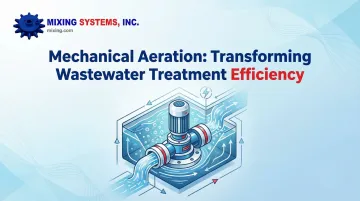
Mechanical aeration provides a practical solution for municipal and industrial wastewater treatment, introducing dissolved oxygen while maintaining thorough mixing. Unlike systems that rely solely on compressed air, mechanical aeration uses motor-driven equipment to agitate wastewater and transfer atmospheric oxygen directly.
This approach supports the aerobic microorganisms that break down organic pollutants and restore water quality, with decades of proven performance across industrial and municipal applications.
TLDR: Key Takeaways
- Mechanical aerators introduce oxygen through surface agitation (impellers, paddle wheels) or submerged turbulence (jet systems)
- Optimized systems reduce energy consumption by 20-40% with DO controls and variable speed drives
- Jet aeration systems eliminate in-basin moving parts, placing all mechanical components outside tanks for maintenance-free operation
- Selection depends on tank depth, mixing requirements, maintenance capabilities, and treatment objectives
- Maintaining DO levels between 1.5-2.0 mg/L prevents both under-treatment and energy waste
What is Mechanical Aeration in Wastewater Treatment?
Mechanical aeration uses motor-driven equipment—impellers, rotors, mixers, or jet systems—to agitate wastewater and introduce atmospheric oxygen.
This oxygen supports aerobic microorganisms that metabolize organic pollutants (measured as BOD and COD), converting them into carbon dioxide, water, and biomass during biological treatment.
Where Mechanical Aeration Fits in Treatment
Mechanical aeration primarily operates during secondary treatment in the activated sludge process, where biological oxidation occurs. It also appears in primary grit chambers for odor control and in tertiary post-aeration stages to restore dissolved oxygen before discharge.
What Sets Mechanical Aeration Apart
Mechanical systems differ from diffused aeration in several key ways:
- Use mechanical energy instead of compressed air diffusion
- Rely on motors, impellers, and mixers to create turbulence
- Draw in atmospheric oxygen through agitation rather than submerged diffusers
- Position mechanical assemblies outside tanks for easier maintenance
Global Adoption
These technical advantages have driven significant market growth. The global wastewater treatment aerators market reached $2.3 billion in 2024, with projected growth exceeding 5% annually through 2034, driven by urbanization and stricter effluent regulations.
How Mechanical Aeration Works: The Science Behind the Process
Dual Function: Oxygen Transfer and Mixing
Mechanical aeration performs two critical functions simultaneously:
- Oxygen Transfer - Moving atmospheric oxygen into the water phase where microorganisms can use it
- Mixing - Keeping solids suspended, preventing dead zones, and maintaining uniform conditions throughout the basin
The Oxygen Transfer Mechanism
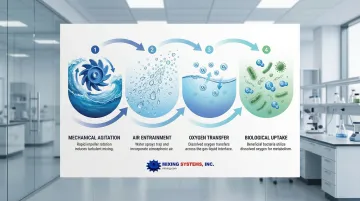
Mechanical devices create turbulence and dramatically increase the water-air interface area. As water droplets spray into the air or as turbulent zones form beneath the surface, atmospheric oxygen dissolves into the wastewater. The greater the interface area and contact time, the more efficient the transfer.
Biological Oxidation Process
This dissolved oxygen fuels the entire treatment process. Aerobic bacteria and microorganisms consume it during respiration while metabolizing organic matter.
This biological oxidation reduces BOD (Biochemical Oxygen Demand) and COD (Chemical Oxygen Demand), the primary pollutant measures in wastewater. Without adequate dissolved oxygen, these microorganisms become inactive and treatment performance collapses.
Key Performance Metrics
Two metrics define system performance:
- Oxygen Transfer Efficiency (OTE) - Measures what percentage of oxygen introduced actually dissolves into the water
- Standard Oxygen Transfer Rate (SOTR) - Measures the pounds or kilograms of oxygen transferred per hour under standard conditions (clean water, 20°C, zero DO)
These metrics allow operators to compare technologies and optimize system performance.
Factors Affecting Transfer Rates
- Water temperature - Higher temperatures increase diffusion rates but decrease oxygen solubility
- Wastewater composition - Surfactants and solids reduce transfer efficiency (measured by the alpha factor, typically 0.7-0.85 for mechanical systems)
- Mixing intensity - More vigorous agitation increases the alpha factor by counteracting surfactant effects
- Equipment design - Impeller geometry, submergence depth, and rotational speed all influence performance
Types of Mechanical Aeration Systems
Surface Aerators (Mechanical Aerators)
Surface aerators operate at the water surface using floating or fixed impellers that spray water into the air, maximizing oxygen contact through atmospheric exposure.
Primary Applications:
- Lagoon systems
- Oxidation ditches
- Large aeration basins with depths up to 3-4 meters
Key Advantages:
- Low capital costs and simple installation
- Portability with floating units
- Easy maintenance with accessible motors
- Effective thermal destratification preventing icing
- Suitable for fluctuating water levels
Submerged Turbine Aerators
Unlike surface systems, submerged turbine aerators position impellers below the water surface. They draw air down through a hollow shaft and disperse it as fine bubbles while providing vigorous mixing.
Suitability:
- Deep tanks up to 15 meters (50 feet)
- High-strength industrial wastewater
- Applications requiring independent mixing control
Advantages:
- Excellent mixing independent of air flow
- Minimal submerged maintenance requirements
- No susceptibility to icing
Jet Aeration Systems
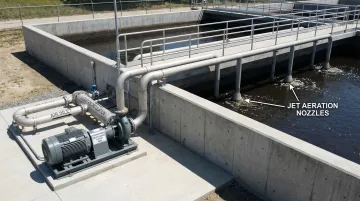
Jet aeration systems take a different approach, using pumps to create high-velocity water jets that entrain and mix air. This generates multiple oxygen transfer zones with fine micro-bubbles for efficient oxygen dissolution.
Unique Advantages:
- All mechanical components located outside the tank for easy maintenance access
- No in-basin moving parts to fail or require servicing
- Horizontal plume injection maintains the gas/liquid interface longer than vertical diffusion
- Optional pneumatic backflush prevents clogging without manual intervention
- Energy reductions of 20-40% compared to conventional methods through superior oxygen transfer efficiency
Mixing Systems, Inc. has specialized in jet aeration technology since 1985, supplying systems to major industrial clients including BASF, Dow Chemical, Pfizer, and Cargill.
Their engineered-to-order approach places all serviceable components outside treatment basins, eliminating confined-space entry during routine maintenance.
Paddle Wheel Aerators
For directional flow applications, paddle wheel aerators use rotating paddle assemblies that churn the water surface. These are commonly deployed in oxidation ditches and raceway-style treatment systems.
Effectiveness:
- Long, narrow channels requiring directional flow
- Provide both aeration and propulsion in a single unit
Brush Aerators
Brush aerators feature cylindrical brush-like rotors mounted horizontally that rotate partially submerged, creating splashing and mixing action.
Application:
- Oxidation ditch configurations
- Maintaining directional velocity (>0.3 m/s) to prevent solids settling
Mechanical Aeration vs. Diffused Aeration: A Comparison
When to Choose Mechanical Aeration
- Shallow basins or lagoons
- Applications requiring strong mixing and solids suspension
- Facilities without existing compressed air infrastructure
- Where maintenance accessibility is prioritized
- Oxidation ditches requiring directional flow
When to Choose Diffused Aeration
- Deep tanks (>15 feet) where depth improves efficiency
- Facilities with existing air compression systems
- Applications where minimizing surface area is important
- When highest possible oxygen transfer efficiency is required
Benefits of Mechanical Aeration for Wastewater Treatment Facilities
Mechanical aeration systems deliver measurable advantages across three critical dimensions: day-to-day operations, long-term economics, and treatment performance. Understanding these benefit categories helps facility managers evaluate whether mechanical aeration aligns with their operational priorities.
Operational Benefits
- Thorough mixing prevents dead zones and ensures uniform dissolved oxygen distribution
- Flexible operation with variable speed controls adjusts to changing loads
- Submerged and jet systems avoid mist and spray issues common with some surface aerators
- Prevents icing through temperature mixing that eliminates stratification in cold climates
- Deep tank capability with submerged turbine and jet systems
These operational advantages translate directly into cost reductions over the system's lifespan.
Economic Benefits
- Reduced capital costs compared to diffused systems requiring blowers and piping
- Lower maintenance expenses with accessible above-tank components
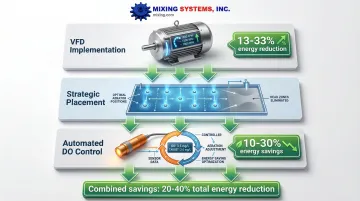
- Energy savings of 20-40% with optimized systems using variable frequency drives (VFDs) and dissolved oxygen (DO) controls
- Longer equipment lifespan as systems resist fouling better
Beyond operational and economic gains, mechanical aeration directly improves the biological treatment process itself.
Treatment Performance Benefits
- Superior solids suspension maintains biological activity throughout the basin
- Consistent DO distribution supports stable microbial populations
- Enhanced biological activity through thorough contact between microorganisms and substrate
- Variable load handling adjusts quickly to influent fluctuations
For facilities processing high-strength industrial wastewater—such as food processing or pharmaceutical operations—consistent DO levels prove especially critical. Fluctuating oxygen availability can crash microbial populations, leading to treatment failures and potential permit violations.
Optimizing Mechanical Aeration Efficiency
Dissolved Oxygen Monitoring and Control
Maintaining optimal DO levels is critical to balancing treatment effectiveness with energy consumption. Research confirms that DO levels between 1.5-2.0 mg/L are ideal for activated sludge processes, with nitrification requiring levels above 2.0 mg/L.
Operating below 0.5 mg/L makes aerobic bacteria inactive. Excessive DO above 3.0 mg/L wastes energy without improving treatment.
Energy Optimization Strategies
Modern aeration systems offer multiple pathways to reduce power consumption while maintaining treatment performance.
Variable Frequency Drives (VFDs):
- Dynamically adjust aerator speed based on real-time DO readings
- Reduce energy consumption during low-load periods
- Case studies show VFD implementation reducing energy use by 13-33%
Strategic Aerator Placement:
- Eliminates dead zones through optimal positioning
- Maintains adequate mixing velocity (>0.3 m/s in oxidation ditches)
- Match equipment capacity to actual oxygen demand, not theoretical maximum
Automated DO Control:
- Install optical DO sensors with automated feedback loops
- Cycles aerators on/off or adjusts speed to maintain target DO
- Documented energy savings of 10-30% from tight DO control
Systems like jet aerators benefit particularly from these optimization strategies, as their external mechanical assemblies and variable air flow control enable easier implementation of automated controls and adjustments.
Maintenance Best Practices
Consistent maintenance ensures sustained efficiency and prevents costly failures:
- Regular inspection schedules - Weekly visual checks of motors, gearboxes, and mounting structures
- Performance monitoring - Track power consumption, DO levels, and effluent quality to identify efficiency trends
- Preventive maintenance - Lubricate bearings, check electrical connections, and replace worn components before failure
- DO sensor calibration - Calibrate optical sensors quarterly using water-saturated air method; replace sensor caps every 1-2 years
- Operational logs - Maintain detailed records to identify patterns and optimize settings
Frequently Asked Questions
What is mechanical aeration in wastewater treatment?
Mechanical aeration uses motor-driven equipment to introduce oxygen into wastewater by creating turbulence and increasing the water-air interface. This dissolved oxygen supports aerobic microorganisms that break down organic pollutants.
How does mechanical aeration differ from diffused aeration in wastewater treatment?
Mechanical systems use motors to agitate water and entrain atmospheric oxygen, while diffused systems use blowers to force air through submerged diffusers. Mechanical aeration excels in shallow applications and mixing; diffused systems perform better in deep tanks.
What equipment is required for mechanical aeration systems in wastewater treatment?
Core equipment includes the aerator unit (surface aerator, submerged jet system, paddle wheel), motor and drive assembly, mounting structure, electrical controls with VFDs, and dissolved oxygen monitoring with automated feedback.
What are the main types of aeration used in wastewater treatment?
The three main categories are mechanical aeration (surface aerators, submerged jet systems, turbines, paddle wheels), diffused aeration (fine bubble and coarse bubble diffusers), and hybrid systems. Jet aeration offers energy advantages through enhanced oxygen transfer in deep tanks.
What are the energy costs associated with mechanical aeration systems?
Aeration represents 45-75% of a treatment plant's total energy consumption. Properly designed mechanical systems with VFDs and DO controls can reduce aeration energy by 20-40% compared to unoptimized systems, delivering significant cost savings.
How do you maintain mechanical aeration equipment?
Key maintenance includes regular inspections of motors and gearboxes, lubrication of bearings, checking electrical connections, cleaning or replacing worn components, and calibrating DO sensors quarterly.