Key Takeaways
- Aeration systems transfer oxygen to bacteria that break down organic pollutants
- The market is growing at 5.5-7.2% annually, fueled by energy efficiency mandates and regulatory compliance
- Three primary technologies: diffused aeration, surface aeration, and jet aeration
- Prioritize oxygen transfer efficiency, energy consumption, and total cost of ownership
- Top providers offer proven technology with documented performance across industrial applications
Overview of Wastewater Aeration Systems in the Global Market
Wastewater aeration systems inject oxygen into treatment basins to support aerobic bacteria that consume organic pollutants, converting them into carbon dioxide, water, and biomass. This biological process is the workhorse of modern wastewater treatment, handling everything from municipal sewage to high-strength industrial effluent.
Market Context
The 2024 market stands at $4.5 billion, with projections reaching $8.9 billion by 2034. Growth drivers include:
- Urbanization: Expanding populations increase sewage volumes, requiring new capacity
- Industrial expansion: Food processing, chemical, and pharmaceutical sectors generate high-strength wastewater
- Regulatory tightening: Nutrient discharge limits (nitrogen, phosphorus) under frameworks like the EPA's NPDES program demand advanced biological treatment
- Energy mandates: Utilities face pressure to reduce carbon footprints, making energy-efficient aeration a priority
Primary Aeration Technologies
Four core technologies dominate the market:
Fine-Bubble Diffused Aeration
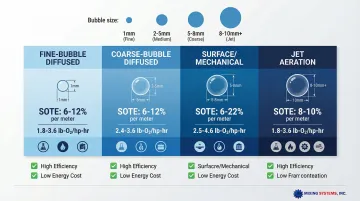
- Compressed air passes through porous membranes, creating 1-3mm bubbles that rise slowly
- Delivers 6.5 lb-O2/hp-hr and 15-30% Standard Oxygen Transfer Efficiency (SOTE)
- Municipal treatment standard for activated sludge systems
Coarse-Bubble Diffused Aeration
- Larger orifices produce 3-10mm bubbles with lower efficiency (2.0 lb-O2/hp-hr)
- Greater fouling resistance in high-solids applications
- Best for sludge digestion and grit chambers
Surface & Mechanical Aeration
- Propellers or turbines agitate the surface, drawing air into the water
- Moderate efficiency (3.0 lb-O2/hp-hr) with strong mixing capability
- Common in lagoons and oxidation ditches
Jet Aeration
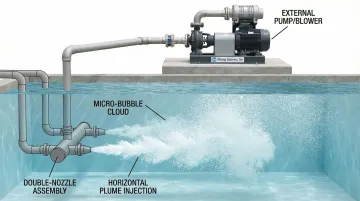
- Recirculated liquid mixes with compressed air in submerged nozzles, generating micro-bubbles (0.1-1mm)
- Horizontal plumes extend gas-liquid contact time, achieving 20-35% SOTE
- Virtually no in-basin moving parts, reducing maintenance requirements
These technologies form the foundation for the manufacturers profiled in the following sections, each offering distinct engineering approaches to biological treatment challenges.
Top Wastewater Aeration System Companies in 2025
The following companies represent industry leaders in wastewater aeration technology for 2025. Selection criteria include global reach, technological innovation, energy efficiency capabilities, and proven track records across municipal and industrial applications.
Xylem Inc.
Background: Global water technology leader serving 150+ countries with a comprehensive wastewater treatment portfolio.
The company serves municipal utilities and industrial sectors including food & beverage, chemical processing, and pulp & paper.
Key Differentiators: Advanced fine-bubble diffuser technology with documented SOTE up to 60% (depth-dependent). Heavy R&D investment in energy optimization—installations like Stadtwerke Trier achieved 20% aeration energy reductions using AI-driven controls.
Integrated IoT monitoring through Xylem Vue platform enables real-time blower optimization.
| Core Technology | Key Industries Served | Notable Strengths |
|---|---|---|
| Fine-bubble diffused aeration systems, membrane aeration, surface aerators | Municipal wastewater, food & beverage, chemical processing, pulp & paper | Global service network, comprehensive product range, proven energy savings of 20-35% |
Evoqua Water Technologies
Background: Leading provider with 100+ years of combined heritage brands (Sanitaire, Envirex, Davco).
Strong focus on industrial applications with extensive municipal installations.
Key Differentiators: Sanitaire diffused aeration systems are an industry benchmark. Modular design flexibility allows customization for diverse basin geometries.
The company demonstrates ROI through energy optimization services and comprehensive aftermarket support for legacy equipment.
| Core Technology | Key Industries Served | Notable Strengths |
|---|---|---|
| Sanitaire ceramic and membrane diffusers, coarse-bubble systems, blower packages | Municipal utilities, pharmaceutical, food processing, petrochemical refineries | Market-leading diffuser technology, comprehensive aftermarket support, energy optimization services |
Mixing Systems, Inc.
Background: Specialized manufacturer since 1985 with over 40 years of engineering expertise in submerged jet aeration and jet mixing systems.
Serves Fortune 500 clients globally including BASF, Dow Chemical, Procter & Gamble, and Pfizer.
Key Differentiators:
- Proprietary jet aeration technology with no in-basin moving parts
- Energy reductions up to 40% versus conventional methods
- Generates micro-bubbles (0.1-1mm) through double-nozzle arrangement
- Horizontal plume injection extends gas-liquid contact time beyond conventional diffused air systems
- Optional pneumatic backflush eliminates clogging
- Virtually maintenance-free operation with deep tank capability
| Core Technology | Key Industries Served | Notable Strengths |
|---|---|---|
| Submerged jet aerators with double nozzle arrangement, jet mixing systems, pneumatic backflush capability | Chemical, petrochemical, pharmaceutical, food & beverage, pulp & paper, municipal wastewater | Superior oxygen transfer efficiency (20-35% SOTE), virtually maintenance-free operation, deep tank capability, custom-engineered solutions, proven installations at major Fortune 500 facilities |
Sulzer Ltd.
Background: Swiss-based industrial engineering company headquartered in Winterthur, with wastewater treatment division offering rotating biological contactors and aeration equipment. Built to European engineering standards and energy-efficient mechanical aeration.
Key Differentiators: Strong presence in industrial wastewater treatment with robust mechanical design. European market leadership with worldwide service organization.
Specializes in turbocompressors and submersible aerators (XTA/XTAK series).
| Core Technology | Key Industries Served | Notable Strengths |
|---|---|---|
| Surface aerators, submersible mixers, rotating biological contactors | Municipal wastewater, mining, oil & gas, chemical manufacturing | Robust mechanical design, European market leadership, integrated treatment system capabilities |
Flucon Pumps
Background: Specialized manufacturer of submersible pumps and aeration equipment with focus on cost-effective solutions for emerging markets. Operational hubs in Riyadh and Amman.
Key Differentiators: Competitive pricing structure with simplified installation requirements.
Suitable for small to medium-scale facilities and retrofit applications where budget constraints are primary considerations.
| Core Technology | Key Industries Served | Notable Strengths |
|---|---|---|
| Submersible aerators, fountain aerators, aspirating aerators | Municipal wastewater, aquaculture, small industrial facilities | Value-oriented pricing, ease of installation, suitable for retrofit applications |
How to Choose the Right Wastewater Aeration System Provider
Avoid Common Selection Mistakes
Many buyers focus solely on upfront capital cost, overlooking the fact that energy expenses over a system's 15-20 year lifespan far exceed initial investment. Watch for these common pitfalls:
- Neglecting energy consumption analysis (aeration represents 50-60% of plant electricity)
- Overlooking maintenance complexity and spare parts availability
- Failing to verify provider experience in similar applications
Prioritize Oxygen Transfer Efficiency (OTE)
Standard Oxygen Transfer Efficiency (SOTE) measures the percentage of supplied oxygen that dissolves into water under standardized conditions (clean water, zero dissolved oxygen, 20°C, 1 atm). This metric directly impacts operational costs.
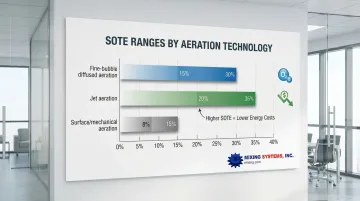
Typical SOTE Ranges by Technology:
| Technology | SOTE Range |
|---|---|
| Fine-bubble diffused | 15-30% |
| Jet aeration | 20-35% |
| Surface/mechanical | 8-15% |
Higher SOTE means less air (and energy) required to deliver the same treatment performance.
When evaluating providers, request SOTE data tested per ASCE/EWRI 2-06 standards.
Analyze Energy Consumption Rigorously
Demand specific kWh per kg O2 transferred data. Technologies vary widely:
- Fine-pore diffusers: 2-8 kg O2/kWh
- Jet aerators: 1.2-2.1 kg O2/kWh
- Mechanical aerators: 1-2 kg O2/kWh
Evaluate total system efficiency, including blower efficiency and pressure losses. Variable frequency drives (VFDs) on blowers can unlock significant savings by matching air supply to real-time demand.
Maintenance Requirements: What to Expect
| Technology | Maintenance Frequency | Key Maintenance Tasks |
|---|---|---|
| Diffused Aeration | Every 2-5 years | Membrane cleaning to prevent fouling; membrane replacement every 5-10 years; in-basin work requires draining or diver access |
| Mechanical Aerators | Weekly inspections | Visual checks for vibration, cable stretch; motor, gearbox, and bearing maintenance; accessible above water but subject to mechanical wear |
| Jet Aeration | Minimal in-basin work | All mechanical assemblies external to basin for easy access; pump maintenance similar to standard recirculation pumps; optional backflush systems reduce nozzle clogging |
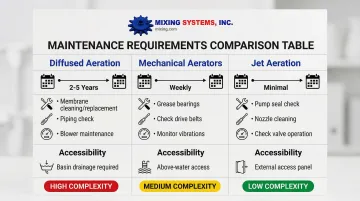
Providers like Mixing Systems, Inc. design jet systems with no in-basin moving parts, reducing maintenance complexity and allowing service without tank drainage.
Verify Application-Specific Experience
Request case studies documenting performance in your industry. Key questions:
- Has the provider successfully treated similar wastewater characteristics (COD, BOD, suspended solids)?
- Can they provide references from facilities of comparable size?
- Do they offer customization for unique basin geometries or retrofit constraints?
Conclusion
Selecting the right wastewater aeration system provider requires balancing three critical factors: technical performance (oxygen transfer efficiency), operational economics (energy and maintenance costs), and long-term partnership (technical support, scalability, and proven reliability). The decision impacts your facility's efficiency and costs for decades.
Prioritize total cost of ownership analysis over initial capital cost. A system that costs 20% more upfront but delivers significant energy savings will pay for itself within 2-3 years. Those savings continue for decades.
Request detailed performance guarantees, verify provider experience with similar applications, and evaluate maintenance accessibility.
For facilities requiring high-efficiency solutions in challenging industrial applications, providers like Mixing Systems, Inc. specialize in custom-engineered jet aeration systems. Their installations at Fortune 500 chemical, pharmaceutical, and food processing facilities demonstrate energy savings up to 40% with minimal maintenance requirements.
Frequently Asked Questions
What is the most common aeration system?
Fine-bubble diffused aeration dominates municipal treatment due to superior oxygen transfer efficiency (15-30% SOTE) and established infrastructure. Industrial facilities often select based on specific wastewater characteristics—jet aeration suits high-strength waste, while surface aerators work well in lagoons.
How much energy does a wastewater aeration system consume?
Aeration typically accounts for 50-60% of total treatment plant energy consumption. Fine-bubble systems use 2-8 kg O2/kWh, while mechanical aerators use 1-2 kg O2/kWh. A 1 MGD plant can spend $100,000-$300,000 annually on aeration energy alone.
What is the difference between fine-bubble and coarse-bubble aeration?
Fine-bubble systems (1-3mm bubbles) offer higher oxygen transfer efficiency (15-30% SOTE) but require more maintenance due to fouling. Coarse-bubble systems (3-10mm bubbles) have lower efficiency but greater resistance to clogging, making them suitable for grit chambers and sludge digestion.
How long do wastewater aeration systems typically last?
Service life varies by component: diffuser membranes last 5-10 years, blowers 15-20 years with maintenance, and mechanical aerators 10-15 years. Jet aeration systems can exceed 20 years with minimal maintenance due to no in-basin moving parts, reducing total cost of ownership.
What maintenance is required for aeration systems?
Diffuser systems require cleaning every 2-5 years and membrane replacement every 5-10 years. Mechanical aerators need weekly inspections and routine bearing/motor maintenance. Jet aeration systems require only external pump maintenance, with optional backflush preventing nozzle clogging.
Can aeration systems be retrofitted to existing treatment plants?
Yes. Retrofit feasibility depends on basin configuration, depth, and existing infrastructure. Fine-bubble retrofits can reduce energy use by 30-40% but may require blower upgrades or additional mixers. Jet aeration systems often offer easier retrofit installation than technologies requiring extensive basin modifications, as all mechanical components remain external and accessible.